NHA KHOA TÂM AN
NHA KHOA TÂM AN does not pretend dentistry can be made invisible; it designs every encounter so fear has fewer places to grow.
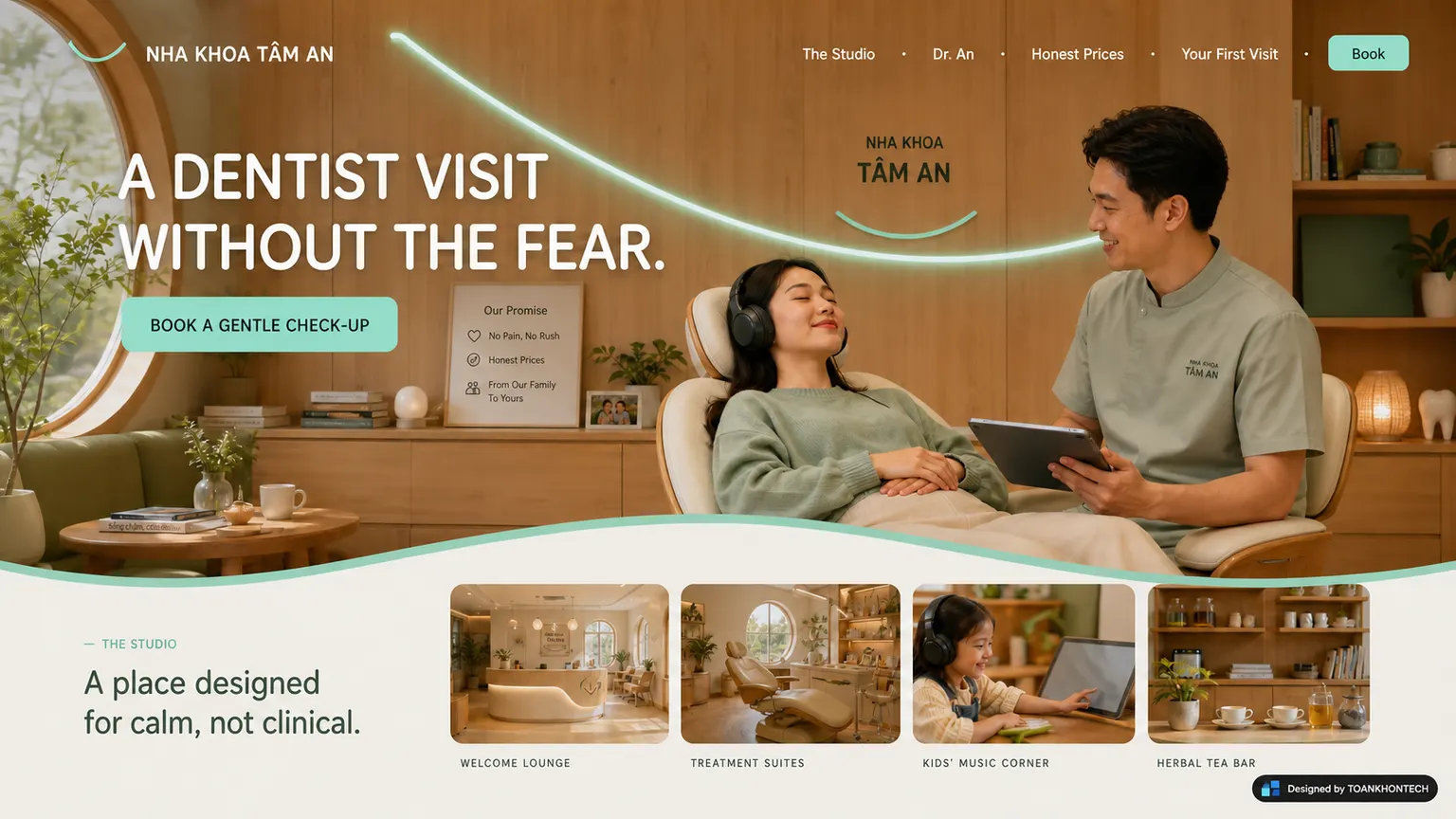
01 · Direction
A clinic measured first by how calm it lets people feel.
The narrative moves from a light-filled room to Dr An, a public fee ledger, and the four steps of a first visit. Each section answers a real anxiety: who will treat me, what will happen, what will it cost, and when can I pause?
Booking should ask only about symptoms, anxiety level, and a workable time. The first appointment is framed as an explained assessment, not a rushed commitment to treatment.
“TÂM AN treats transparency as care: the process is visible, prices are stated, and no patient is required to perform bravery in exchange for kindness.”
- Format
- healthcare service website concept
- Audience
- Patients and families seeking expertise, process, and cost clarity under stress
- Primary proof
- Clinical expertise, care pathways, safety standards, and clear guidance
- Primary action
- Choose a specialty, prepare records, and book
02 · visitor space
Remove dentistry from the visual memory of a hospital.
Pale timber, mint, and natural light make the room feel closer to a conversation than a procedure. Metal instruments never become the dominant image; people are the first signal.
This direction is more than a calming palette. It narrows the emotional distance between patient and clinic before a promise has to do the work.
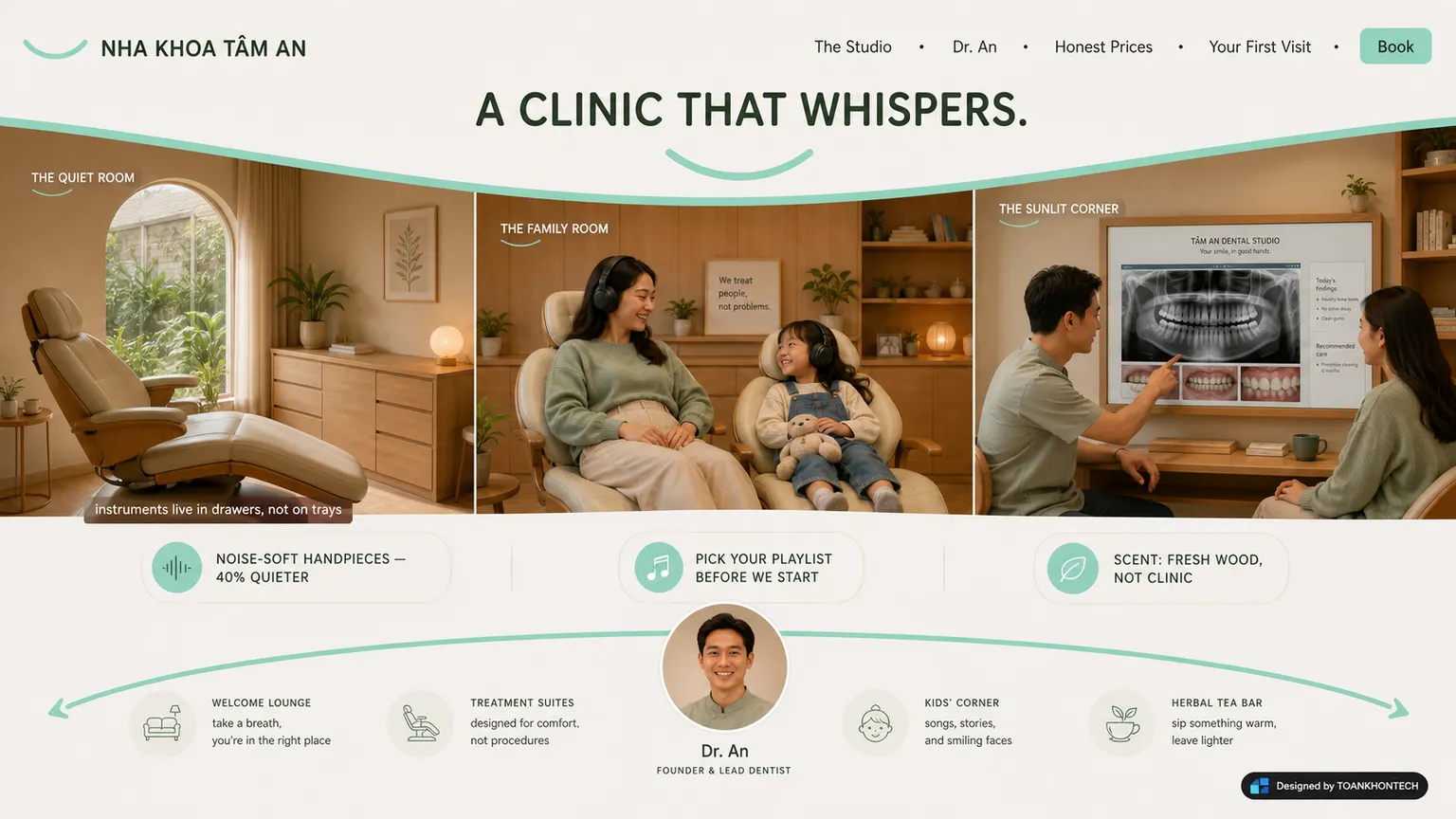
The room must answer one question: will I be heard here?
03 · Story
Introduce Dr An through practice, not rank.
The portrait is paired with an X-ray explanation, an older patient, and a handwritten note. Expertise appears as behaviour: explain clearly, wait for a response, and decide only after the patient understands.
When a clinician profile centres communication, trust becomes more concrete than a detached list of credentials.
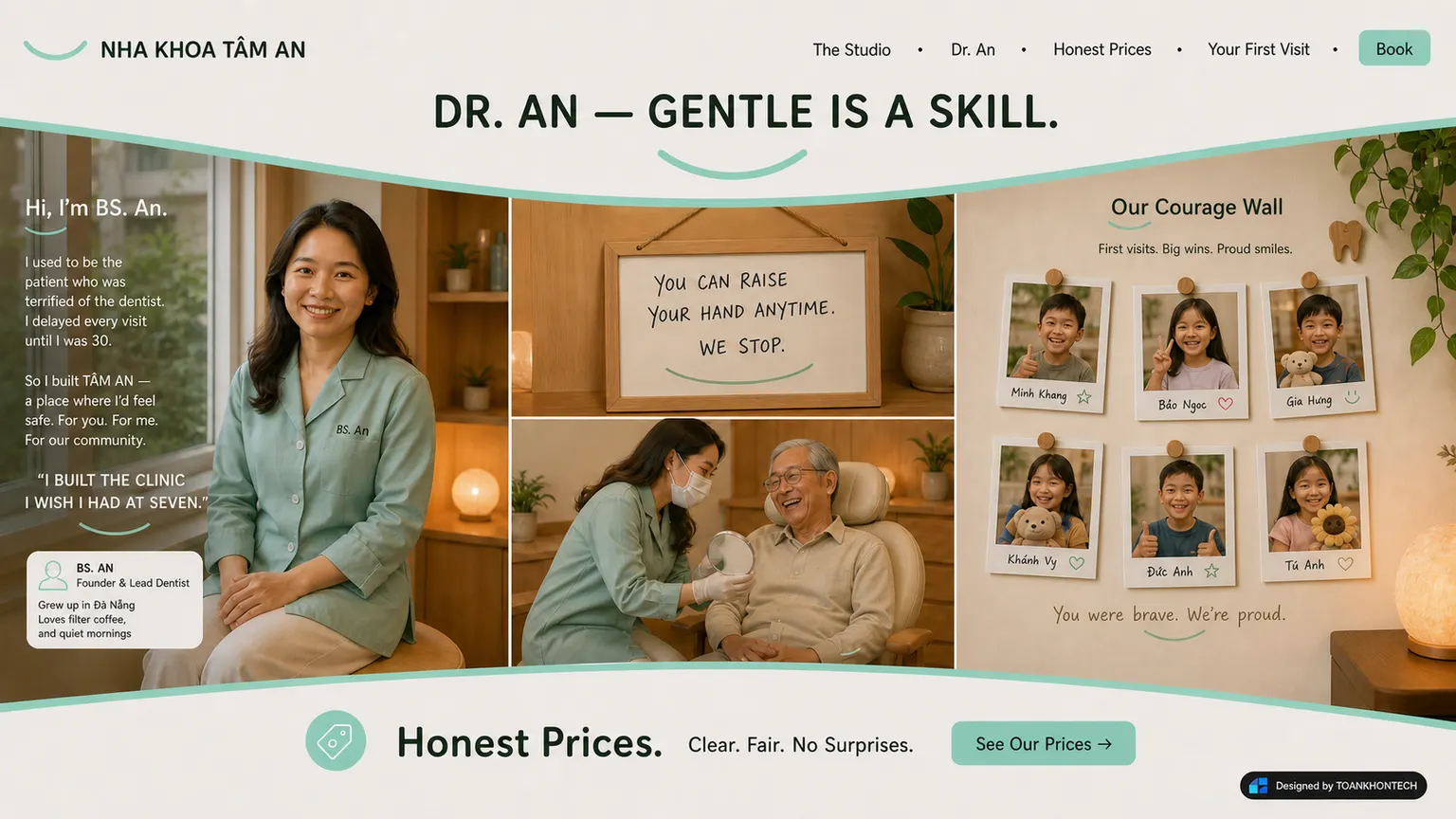
Authority is proven in how a clinical decision is explained.
04 · Prices
Put the price ledger before the chair.
Common fees sit beside what is included and which cases need an individual quote. The language avoids vague asterisks and refuses to use a low entry price to hide a more expensive pathway.
Cost clarity preserves patient agency and removes calls that exist only because the website withheld an answer.
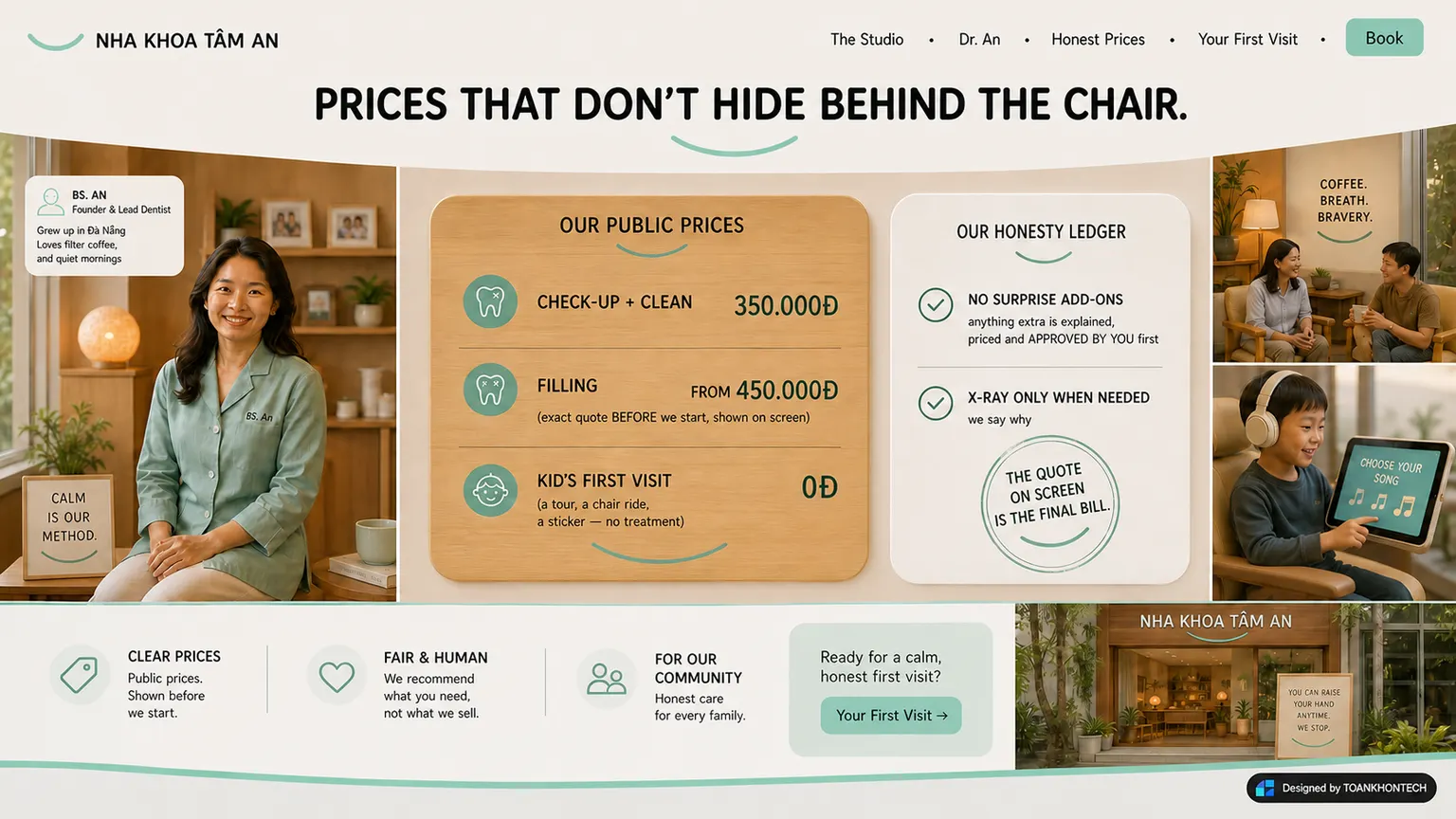
Transparent pricing is part of care, not a sales appendix.
05 · Experience
Four steps, with no surprise turn.
Tea and forms, meeting Dr An, seeing the room, then receiving a plan and quote form a short sequence with visible stopping points. Patients know where they are and whether the next step is optional.
That structure matters to people who have postponed dentistry because they fear losing control; conversion begins with choice.

Never move the visitor faster than they are ready to go.
Design language
Recognise NHA KHOA TÂM AN before the logo has to appear.
The design language follows an institutional system treatment, the concept palette, and its native image rhythm. The goal is not novelty in every section but a small set of rules strong enough to support new content.
- 01
Contrast with a job
Accent colour is reserved for attention and primary action; background, type, and imagery stay stable so NHA KHOA TÂM AN never becomes noise.
- 02
An industry-specific rhythm
Image ratio, paragraph length, and headline placement follow how people actually explore a healthcare service website, not a universal portfolio template.
- 03
Evidence before invitation
Clinical expertise, care pathways, safety standards, and clear guidance arrives before the CTA, making action a reasonable consequence of the story rather than an interruption.
Colour system
#e8e8e0
#905828
#908870
#d8d0c8
#a07850
Colours come directly from NHA KHOA TÂM AN's art direction. Production should validate WCAG contrast for copy, interaction states, and charts instead of assigning every colour equal weight.
Production direction
Turn the concept into a system with content, data, and clear ownership.
The visual design is an opening hypothesis. A live version must be tested with real content, real behaviour, and the technical constraints of the team that will maintain it.
- 01
Inventory content and data
Identify the source, update cadence, and approver for clinical expertise, care pathways, safety standards, and clear guidance before finalising page architecture.
- 02
Prototype the primary flow
Test “Choose a specialty, prepare records, and book” on real devices, including missing data, failure, and interrupted-return states.
- 03
Performance and access
Serve images at display size, preserve semantic HTML, support keyboard use, and respect reduced motion so the experience does not require powerful hardware.
- 04
Measure what matters
Track specialty searches, completed bookings, and sufficiently prepared records, exclude internal traffic, and agree event definitions before interpreting results.
Frequently asked questions
Questions to resolve before producing NHA KHOA TÂM AN.
- Who is NHA KHOA TÂM AN designed for?
- Patients and families seeking expertise, process, and cost clarity under stress. Every layout decision serves one primary action: choose a specialty, prepare records, and book.
- Why does this detail page differ from the other concepts?
- The institutional system treatment follows how people explore a healthcare service website, its information density, and its particular visual language.
- Could the concept become a real website?
- Yes, after replacing assumptions with real content, data, legal requirements, and the organisation's “Choose a specialty, prepare records, and book” process.
- How should effectiveness be measured?
- A useful starting set is specialty searches, completed bookings, and sufficiently prepared records; final targets must follow the real operating model.
Continue exploring
More concepts in the field, each with a different answer.

From concept to product
Have an idea that needs to become a real website?
ToanKhonTech can shape positioning, content architecture, conversion flow, and an interface system for your actual context—without copying a concept wholesale.