NGÀY VUI
NGÀY VUI treats a wedding as engineered seconds that later become one memorable frame, not a menu of decorations.

01 · Direction
The editorial moves from ceremony and venue to real cases, exposing decisions, timeline, and contingency behind apparent ease.
The brief is to make an event and community website that creates desire and helps visitors decide without assembling information from several places. NGÀY VUI is therefore treated as a content and conversion system, not a collection of attractive screens.
Couples choose date, scale, city, and what they do not want, receiving a budget range before a conversation.
“For NGÀY VUI, aesthetics earn their place only when they make programme, artists, venue, schedule, and audience experience easier to see, understand, and act on.”
- Format
- event and community website concept
- Audience
- Audiences assessing programme, atmosphere, schedule, and participation
- Primary proof
- Programme, artists, venue, schedule, and audience experience
- Primary action
- Choose a programme, session, or ticket
02 · Ceremonies
Ceremonies should tell visitors what is worth remembering.
Ceremonies extends the hero promise into a situation a visitor can picture. For NGÀY VUI, the content needs to show what happens, why the detail differs, and which information matters enough to continue exploring.
In production, this module should offer a short scanning layer, deeper verification for people who need it, and a clear route forward. That structure preserves editorial pace without sacrificing search discovery or accessibility.
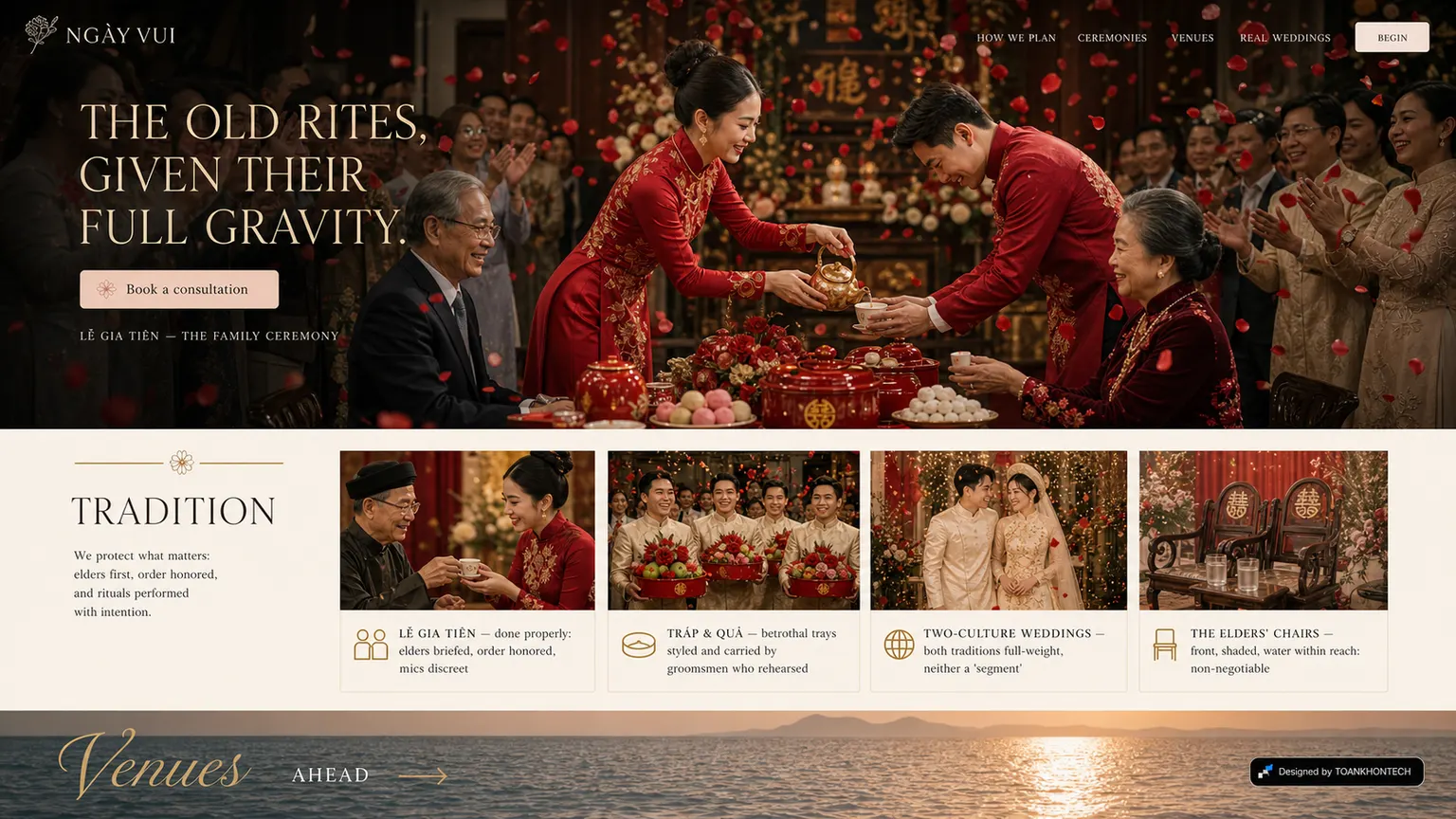
Principle: every artboard must add a reason to believe or a reason to act.
03 · Venues
Venues is not filler; it is evidence.
Venues is an evidence layer for NGÀY VUI's positioning. Instead of adding adjectives, the artboard uses programme, artists, venue, schedule, and audience experience to turn a visual impression into a reason visitors can remember and compare.
Every claim should carry a source, scope, and update date where relevant. That becomes essential when a concept moves towards production: trust comes from verifiable detail, not the volume of brand language.

Principle: every artboard must add a reason to believe or a reason to act.
04 · closing invitation
Place closing invitation at the right moment in the decision.
At the centre of the journey, closing invitation classifies choices and reduces cognitive load. Primary information should scan in seconds; secondary detail opens after visitors know what they care about.
Headings, image captions, and contextual links also help search engines understand the page without keyword repetition. SEO is the outcome of clear information, not a text layer added after design.

Principle: every artboard must add a reason to believe or a reason to act.
Design language
Recognise NGÀY VUI before the logo has to appear.
The design language follows an asymmetric editorial treatment, the concept palette, and its native image rhythm. The goal is not novelty in every section but a small set of rules strong enough to support new content.
- 01
Contrast with a job
Accent colour is reserved for attention and primary action; background, type, and imagery stay stable so NGÀY VUI never becomes noise.
- 02
An industry-specific rhythm
Image ratio, paragraph length, and headline placement follow how people actually explore an event and community website, not a universal portfolio template.
- 03
Evidence before invitation
Programme, artists, venue, schedule, and audience experience arrives before the CTA, making action a reasonable consequence of the story rather than an interruption.
Colour system
#201008
#402810
#584028
#905028
#a87848
Colours come directly from NGÀY VUI's art direction. Production should validate WCAG contrast for copy, interaction states, and charts instead of assigning every colour equal weight.
Production direction
Turn the concept into a system with content, data, and clear ownership.
The visual design is an opening hypothesis. A live version must be tested with real content, real behaviour, and the technical constraints of the team that will maintain it.
- 01
Inventory content and data
Identify the source, update cadence, and approver for programme, artists, venue, schedule, and audience experience before finalising page architecture.
- 02
Prototype the primary flow
Test “Choose a programme, session, or ticket” on real devices, including missing data, failure, and interrupted-return states.
- 03
Performance and access
Serve images at display size, preserve semantic HTML, support keyboard use, and respect reduced motion so the experience does not require powerful hardware.
- 04
Measure what matters
Track programme views, session selection, and ticket completion, exclude internal traffic, and agree event definitions before interpreting results.
Frequently asked questions
Questions to resolve before producing NGÀY VUI.
- Who is NGÀY VUI designed for?
- Audiences assessing programme, atmosphere, schedule, and participation. Every layout decision serves one primary action: choose a programme, session, or ticket.
- Why does this detail page differ from the other concepts?
- The asymmetric editorial treatment follows how people explore an event and community website, its information density, and its particular visual language.
- Could the concept become a real website?
- Yes, after replacing assumptions with real content, data, legal requirements, and the organisation's “Choose a programme, session, or ticket” process.
- How should effectiveness be measured?
- A useful starting set is programme views, session selection, and ticket completion; final targets must follow the real operating model.
Continue exploring
More concepts in the field, each with a different answer.
From concept to product
Have an idea that needs to become a real website?
ToanKhonTech can shape positioning, content architecture, conversion flow, and an interface system for your actual context—without copying a fictional concept wholesale.