TIỆM TÓC ÔNG THỢ
TIỆM TÓC ÔNG THỢ names the work plainly: a haircut is a trade requiring an eye, a hand, time, and responsibility for the shape a client carries out the door.

01 · Direction
A barbershop for the trade, not the theatre.
The site moves through three chairs, Ông Thợ, prices painted on glass, and the five acts of a cut. Noir atmosphere gives the brand character; operational detail makes the promise hold.
Booking selects barber, service, hair length, and time. A guest may upload a current photo, while the interface makes clear that references never guarantee an identical result.
“ÔNG THỢ treats age as evidence of steady work, not nostalgic decoration. Leather, brass, and tools matter only when paired with a service standard that repeats.”
- Format
- craft and artisan brand website concept
- Audience
- Buyers and learners seeking the material, maker, time, and real value behind an object
- Primary proof
- Material source, artisan, process, natural variation, and price construction
- Primary action
- Choose a work, request a commission, or reserve a workshop
02 · visitor space
Three chairs, one standard.
Chair No.1, The Fade Corner, and Waiting Bench become three scenes in one working rhythm. Worn leather and scratched brass keep time visible, while contact surfaces and tools remain clean, bright, and ordered.
The direction distinguishes patina from neglect. A shop that shows age must be especially clear about how it cares for equipment and people.
Age may be aesthetic; hygiene never is.

03 · Story
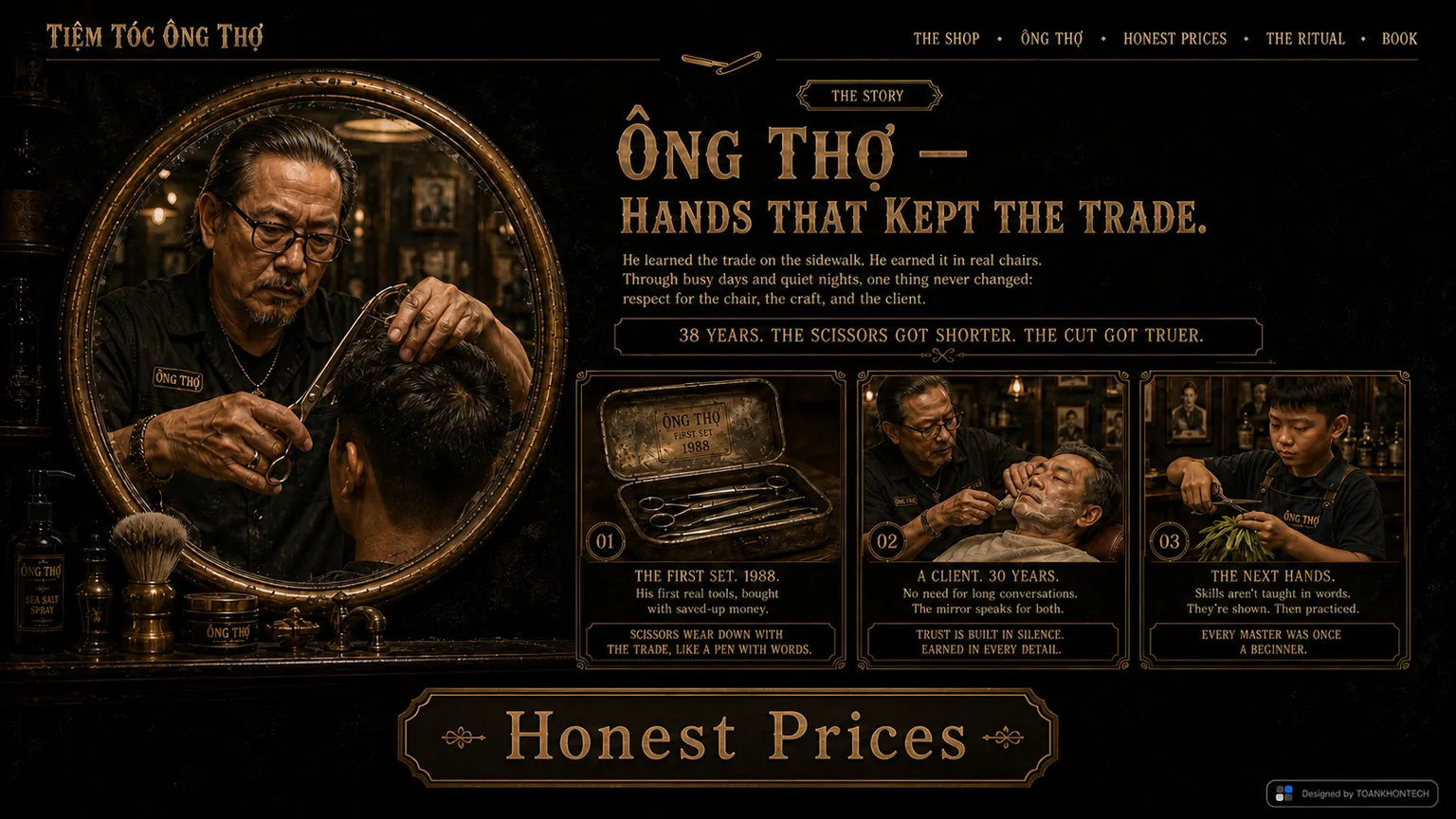
Ông Thợ does not sell one haircut; he reads one head.
The story covers growth pattern, texture, styling habit, and how many weeks a client wants the form to hold. Craft is described through small decisions rather than a myth of instinctive genius.
That language sets a realistic expectation and creates common ground before the cape is fastened.
A good consultation begins with how hair lives after leaving the shop.
04 · Prices
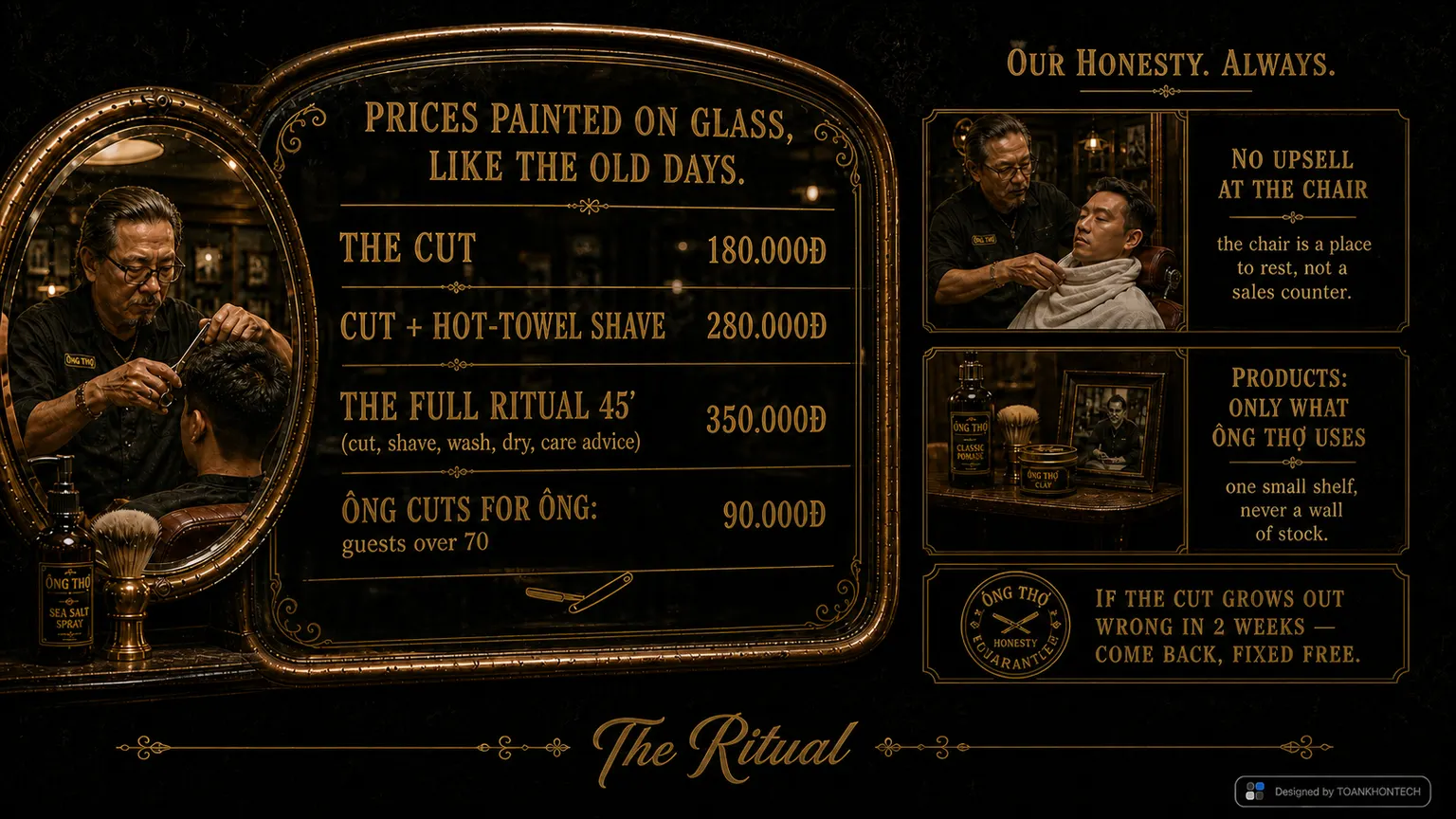
Prices painted on glass to survive the rush.
Cut, cut plus hot towel shave, full ritual, and children's service state duration, scope, and fee. An addition appears only when there is additional work, never after the client is already seated.
A public ledger respects both sides: guests choose the right rhythm and the barber has enough time not to rush the trade.
The price of handwork should reflect real time.
05 · Experience
Forty-five minutes, five acts.
Consultation, cut, hot towel, wash, and finish form a ritual without empty gestures. Each act has a purpose and a moment for the client to check direction.
The flow can power appointment confirmation and internal training, keeping experience from depending entirely on each barber's memory.
A strong ritual is memorable and repeatable.

Design language
Recognise TIỆM TÓC ÔNG THỢ before the logo has to appear.
The design language follows a use-case showroom treatment, the concept palette, and its native image rhythm. The goal is not novelty in every section but a small set of rules strong enough to support new content.
- 01
Contrast with a job
Accent colour is reserved for attention and primary action; background, type, and imagery stay stable so TIỆM TÓC ÔNG THỢ never becomes noise.
- 02
An industry-specific rhythm
Image ratio, paragraph length, and headline placement follow how people actually explore a craft and artisan brand website, not a universal portfolio template.
- 03
Evidence before invitation
Material source, artisan, process, natural variation, and price construction arrives before the CTA, making action a reasonable consequence of the story rather than an interruption.
Colour system
#000000
#201808
#584028
#482810
#785830
Colours come directly from TIỆM TÓC ÔNG THỢ's art direction. Production should validate WCAG contrast for copy, interaction states, and charts instead of assigning every colour equal weight.
Production direction
Turn the concept into a system with content, data, and clear ownership.
The visual design is an opening hypothesis. A live version must be tested with real content, real behaviour, and the technical constraints of the team that will maintain it.
- 01
Inventory content and data
Identify the source, update cadence, and approver for material source, artisan, process, natural variation, and price construction before finalising page architecture.
- 02
Prototype the primary flow
Test “Choose a work, request a commission, or reserve a workshop” on real devices, including missing data, failure, and interrupted-return states.
- 03
Performance and access
Serve images at display size, preserve semantic HTML, support keyboard use, and respect reduced motion so the experience does not require powerful hardware.
- 04
Measure what matters
Track process depth, artisan-profile views, commission enquiries, and workshop reservations, exclude internal traffic, and agree event definitions before interpreting results.
Frequently asked questions
Questions to resolve before producing TIỆM TÓC ÔNG THỢ.
- Who is TIỆM TÓC ÔNG THỢ designed for?
- Buyers and learners seeking the material, maker, time, and real value behind an object. Every layout decision serves one primary action: choose a work, request a commission, or reserve a workshop.
- Why does this detail page differ from the other concepts?
- The use-case showroom treatment follows how people explore a craft and artisan brand website, its information density, and its particular visual language.
- Could the concept become a real website?
- Yes, after replacing assumptions with real content, data, legal requirements, and the organisation's “Choose a work, request a commission, or reserve a workshop” process.
- How should effectiveness be measured?
- A useful starting set is process depth, artisan-profile views, commission enquiries, and workshop reservations; final targets must follow the real operating model.
Continue exploring
More concepts in the field, each with a different answer.
From concept to product
Have an idea that needs to become a real website?
ToanKhonTech can shape positioning, content architecture, conversion flow, and an interface system for your actual context—without copying a concept wholesale.