MÙA RANG COFFEE ROASTERY
MÙA RANG COFFEE ROASTERY treats roasting as the bean's final recipe: heat, time, and judgement recorded clearly enough for tomorrow's batch to improve on today's.

01 · Direction
The bean has an origin. The roast has a signature.
The roastery, roaster, price ledger, and bean archive form one traceability record. Smoke and burnt orange carry visual force, while batch number, roast date, altitude, and process create the reason to buy.
Retail customers choose by brew method, taste, and intended use date. Café enquiries begin with weekly volume, equipment, and profile need rather than a generic wholesale form.
“MÙA RANG turns an open workshop into a brand advantage: a profile is not merely evocative copy, but data repeatable enough to trust and distinctive enough to debate.”
- Format
- provenance-led specialty product website concept
- Audience
- Buyers verifying source, maker, and quality before choosing a regional product
- Primary proof
- Origin coordinates, season, producer, quality measurement, and batch record
- Primary action
- Inspect a batch, choose a format, and buy direct
02 · visitor space
Open the workshop so technique never hides backstage.
The Green Wall, Cooling Tray, and Read-out Bay show how coffee moves through heat. Charts are not technical decoration; they connect first crack, rate of rise, and the result in the cup.
An open roastery gives quality claims a place to be tested and explains why two batches from one source may still differ.
Show the decisions that sit between green bean and cup.

03 · Story
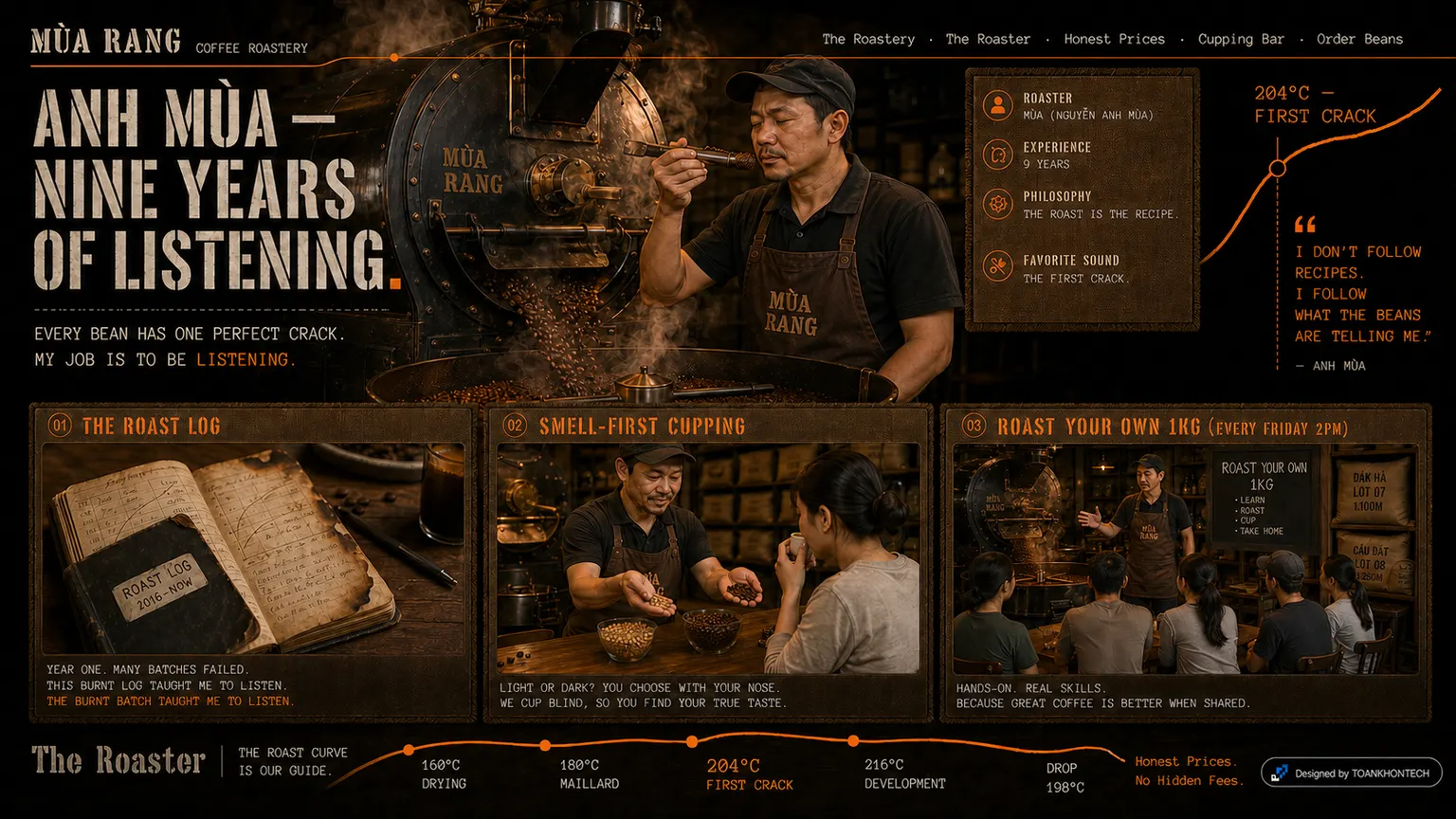
Remember the roaster through the notes they keep.
The portrait moves beyond smoke and flame into batch logs, samples, and the decision to reject a profile that missed. The author of flavour appears as a worker, not an advertising character.
This voice earns authority without romanticising technical failure. Honesty about a poor batch makes the good ones more credible.
Craft has a history of testing, error, and correction.
04 · Prices
Price in grams, roast dates, and origin.
Espresso, filter, and micro-lot differ through information useful to brewing, not premium labels alone. Pack size, roast date, and defective-bean policy sit beside price.
The structure helps a newcomer choose without flattening the distinctions an experienced brewer needs; one ledger serves two levels of knowledge.
Good pricing does not hide specifications to manufacture mystery.

05 · closing invitation
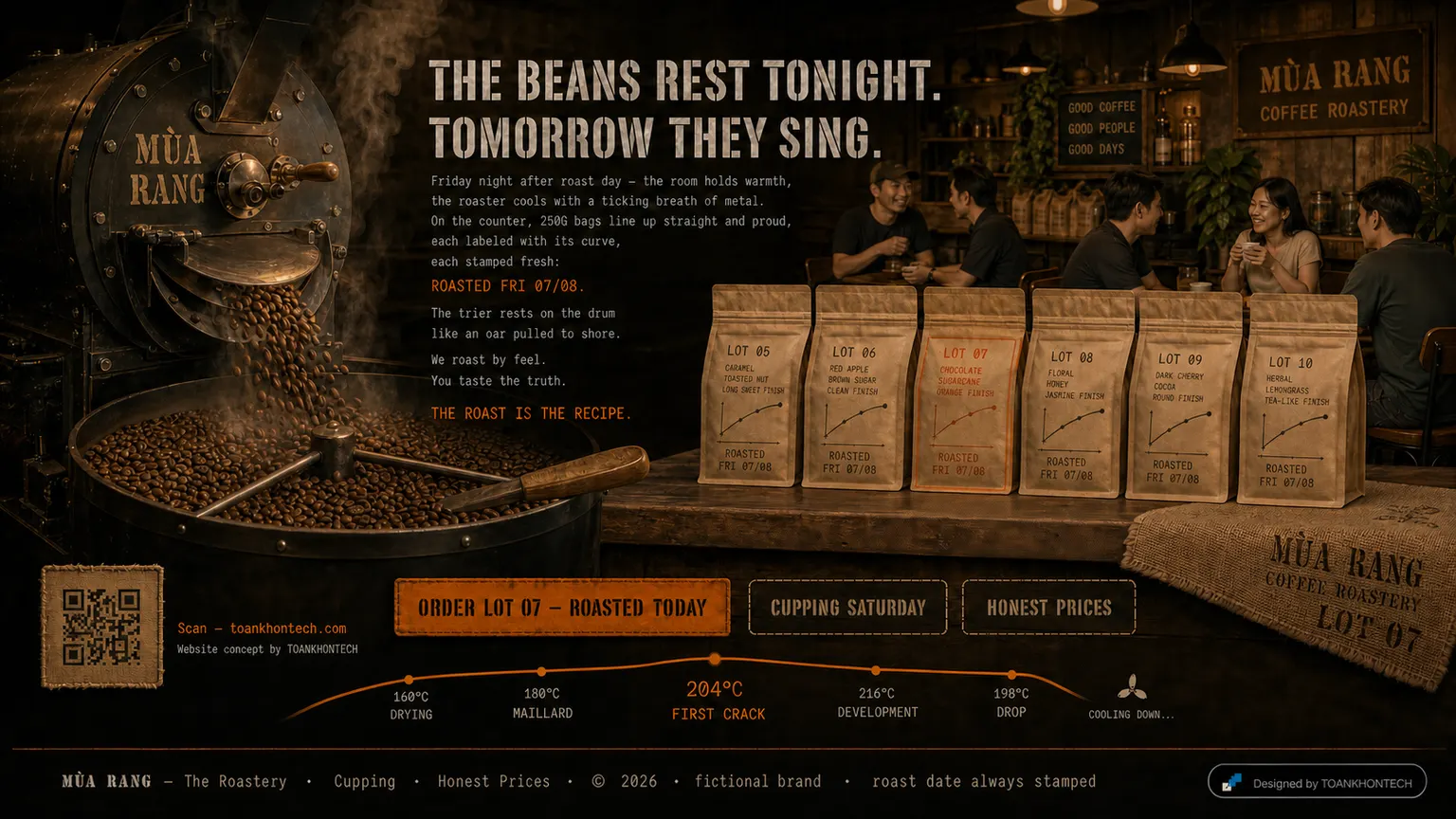
The bean room is a library waiting to be read.
The final board gathers sacks, lot labels, and rest schedules in one scene. Every code keeps region, variety, process, altitude, and roast date, turning stock into a living archive.
In production, that archive can support search, repeat orders, and new-lot alerts; provenance becomes function rather than a long paragraph.
Every bag should keep a route back to where it began.
Design language
Recognise MÙA RANG COFFEE ROASTERY before the logo has to appear.
The design language follows a living archive treatment, the concept palette, and its native image rhythm. The goal is not novelty in every section but a small set of rules strong enough to support new content.
- 01
Contrast with a job
Accent colour is reserved for attention and primary action; background, type, and imagery stay stable so MÙA RANG COFFEE ROASTERY never becomes noise.
- 02
An industry-specific rhythm
Image ratio, paragraph length, and headline placement follow how people actually explore a provenance-led specialty product website, not a universal portfolio template.
- 03
Evidence before invitation
Origin coordinates, season, producer, quality measurement, and batch record arrives before the CTA, making action a reasonable consequence of the story rather than an interruption.
Colour system
#100800
#382008
#604020
#706050
#a86830
Colours come directly from MÙA RANG COFFEE ROASTERY's art direction. Production should validate WCAG contrast for copy, interaction states, and charts instead of assigning every colour equal weight.
Production direction
Turn the concept into a system with content, data, and clear ownership.
The visual design is an opening hypothesis. A live version must be tested with real content, real behaviour, and the technical constraints of the team that will maintain it.
- 01
Inventory content and data
Identify the source, update cadence, and approver for origin coordinates, season, producer, quality measurement, and batch record before finalising page architecture.
- 02
Prototype the primary flow
Test “Inspect a batch, choose a format, and buy direct” on real devices, including missing data, failure, and interrupted-return states.
- 03
Performance and access
Serve images at display size, preserve semantic HTML, support keyboard use, and respect reduced motion so the experience does not require powerful hardware.
- 04
Measure what matters
Track provenance-record opens, product views, add-to-cart, and batch-led repeat purchase, exclude internal traffic, and agree event definitions before interpreting results.
Frequently asked questions
Questions to resolve before producing MÙA RANG COFFEE ROASTERY.
- Who is MÙA RANG COFFEE ROASTERY designed for?
- Buyers verifying source, maker, and quality before choosing a regional product. Every layout decision serves one primary action: inspect a batch, choose a format, and buy direct.
- Why does this detail page differ from the other concepts?
- The living archive treatment follows how people explore a provenance-led specialty product website, its information density, and its particular visual language.
- Could the concept become a real website?
- Yes, after replacing assumptions with real content, data, legal requirements, and the organisation's “Inspect a batch, choose a format, and buy direct” process.
- How should effectiveness be measured?
- A useful starting set is provenance-record opens, product views, add-to-cart, and batch-led repeat purchase; final targets must follow the real operating model.
Continue exploring
More concepts in the field, each with a different answer.

From concept to product
Have an idea that needs to become a real website?
ToanKhonTech can shape positioning, content architecture, conversion flow, and an interface system for your actual context—without copying a concept wholesale.