ROBOTA — XƯỞNG STEM CHO TRẺ
ROBOTA — XƯỞNG STEM CHO TRẺ begins with permission to take something apart, rebuild it badly, and understand why the second attempt works better.
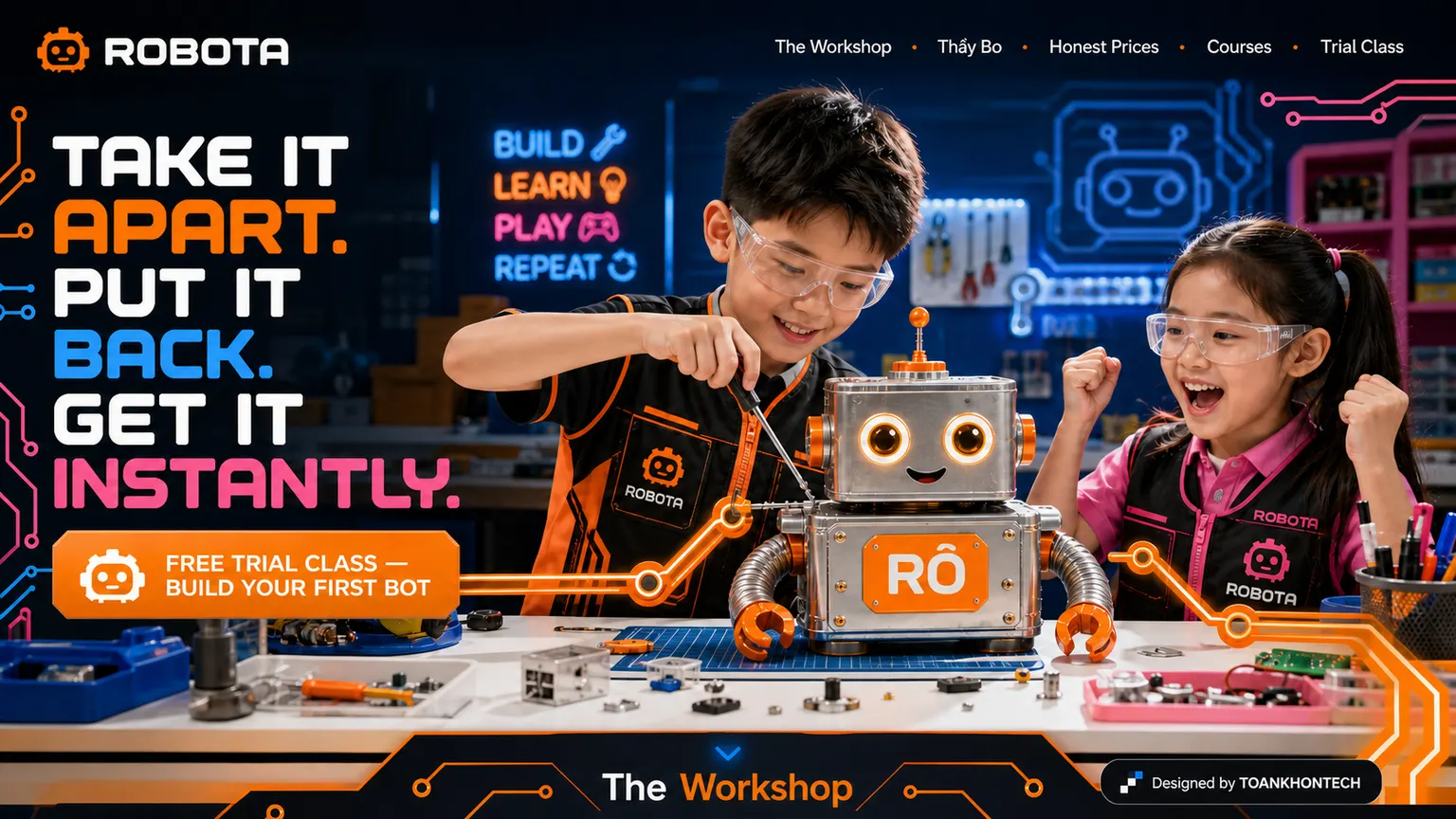
01 · Direction
Take it apart. Put it back. Understand a little more.
A take-apart table, Thầy Bô, board-posted tuition, and three learning levels form a workshop with real tool noise. Electric blue and orange reveal circuits; photography keeps the stuck and retry moments.
A trial asks age, experience, interests, and support needs. The child completes one working robot to take home before the family chooses a longer pathway.
“ROBOTA never uses the robot as a shiny reward. The object is evidence of thought: question, solder error, test run, and an explanation the child can repeat.”
- Format
- education programme website concept
- Audience
- Curious students and parents looking for visible learning proof
- Primary proof
- Student work, pathways, mentors, and feedback
- Primary action
- Choose a programme and book a trial class
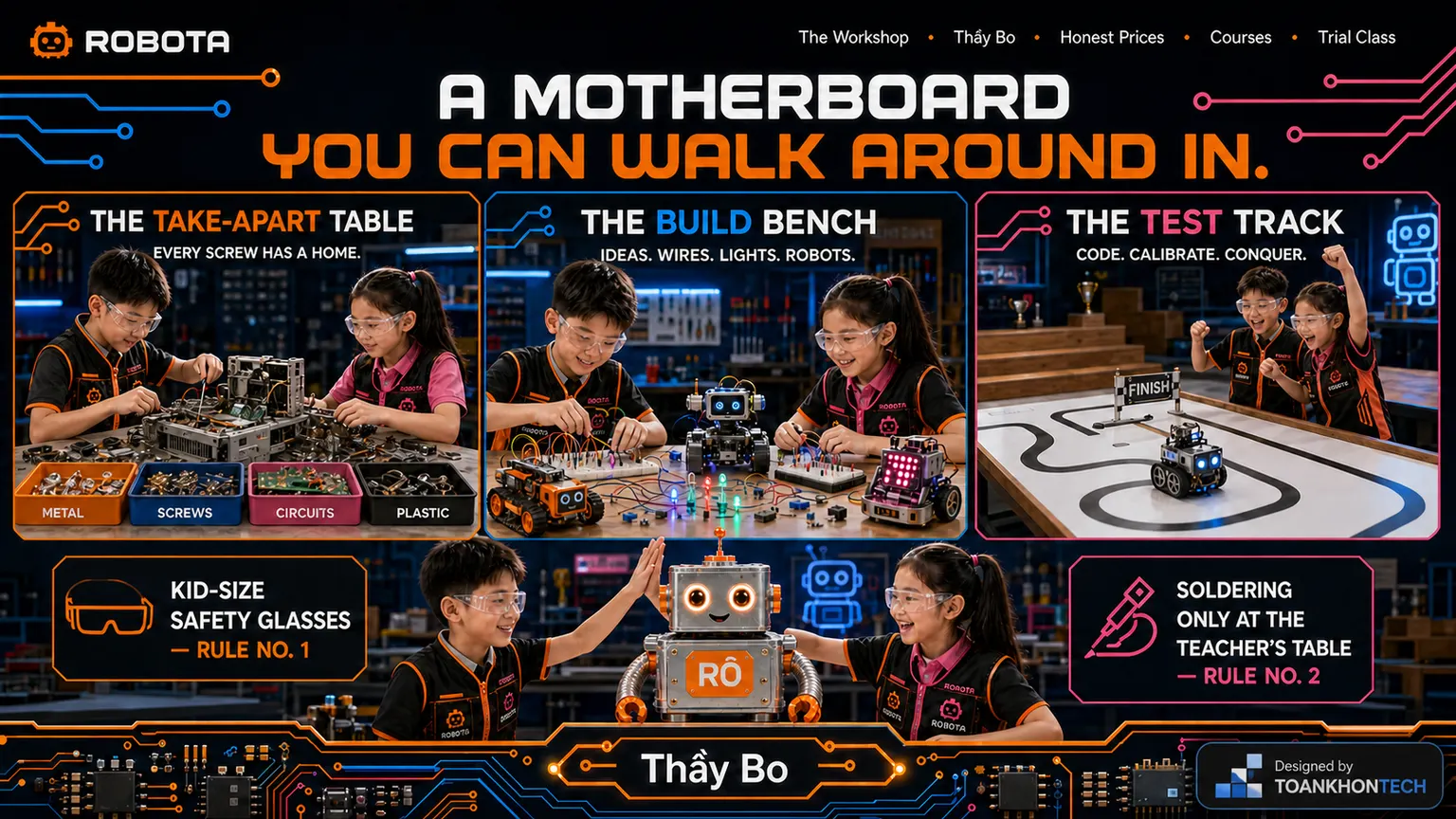
02 · visitor space
A motherboard children may walk around.
Take-apart Table, Build Bench, and Test Track make electronics into three visible actions. Components are sorted, tools have a place, and each bench carries safety rules short enough to remember.
The workshop does not impersonate a miniature adult lab. It preserves precision while making room for small hands, large questions, and repeated attempts.
A good workshop makes error safe to inspect rather than pretending it disappears.
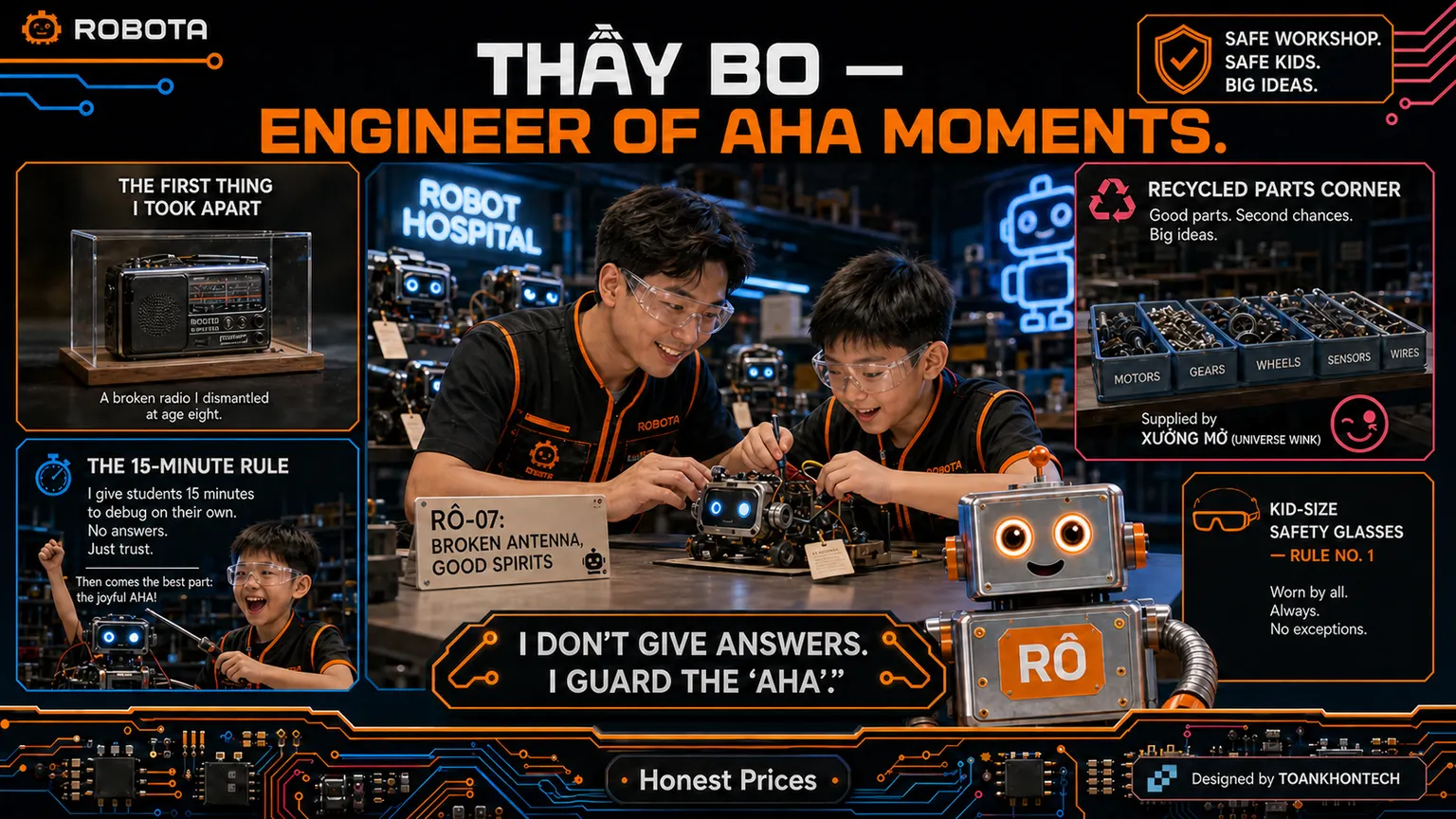
03 · Story
Thầy Bô engineers the aha moment instead of reading out the answer.
The teacher profile follows a support sequence: ask what the child sees, isolate the fault, and wait for two clues to connect. Pedagogy appears in the deliberate delay of an answer.
Parents see a teaching standard rather than a fun personality, allowing the workshop to train a team instead of depending on one character.
A strong teacher never steals the child's moment of discovery.
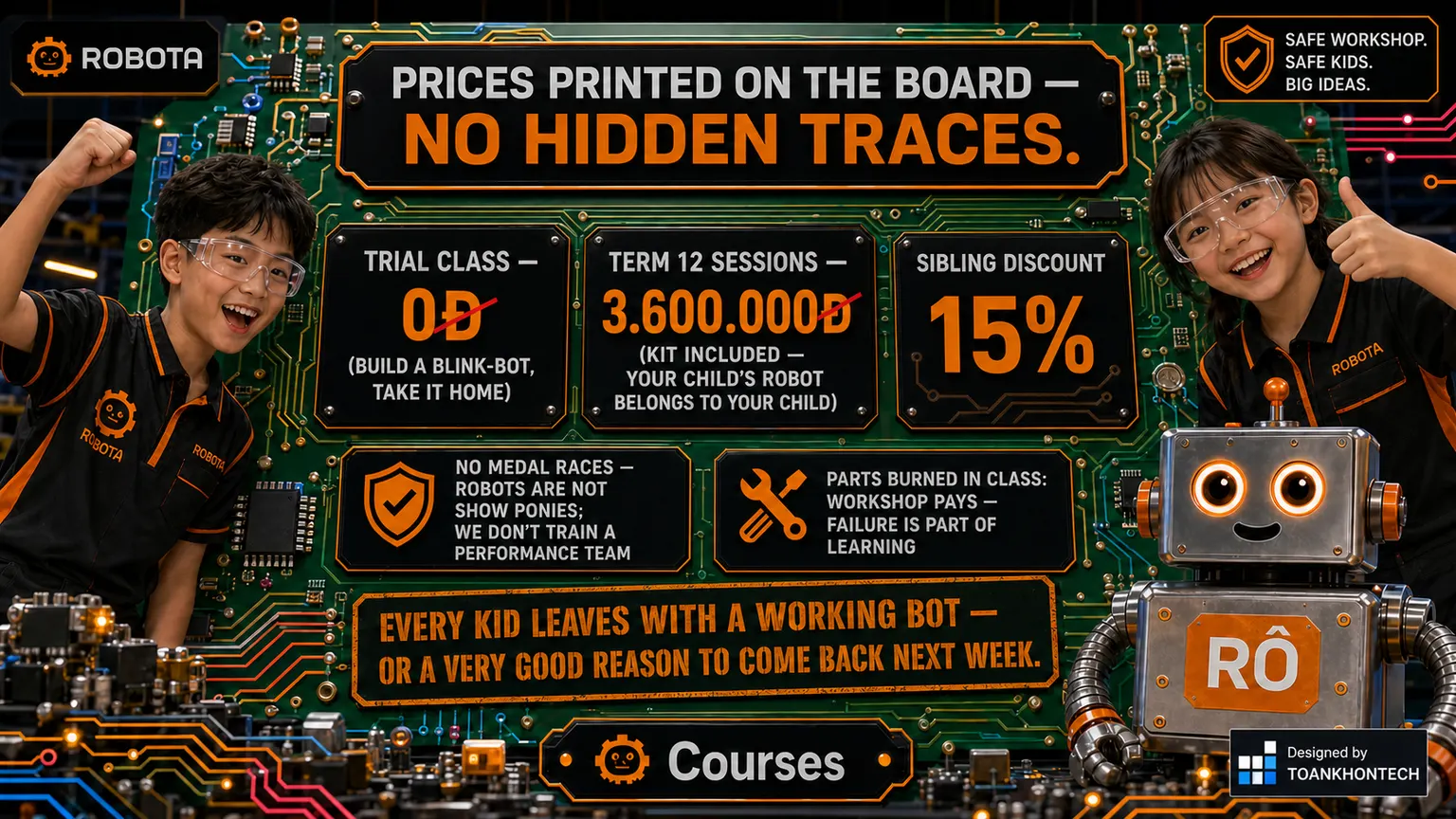
04 · Prices
Tuition on the board, with no hidden circuit.
Trial, term, and sibling discount state which kit is included, what goes home, and when replacement costs apply. Materials never detach from tuition at checkout.
Families can compare true cost and the workshop can protect kit quality rather than covering a shortfall with cheaper components.
A STEM course should disclose both knowledge and materials.
05 · Experience
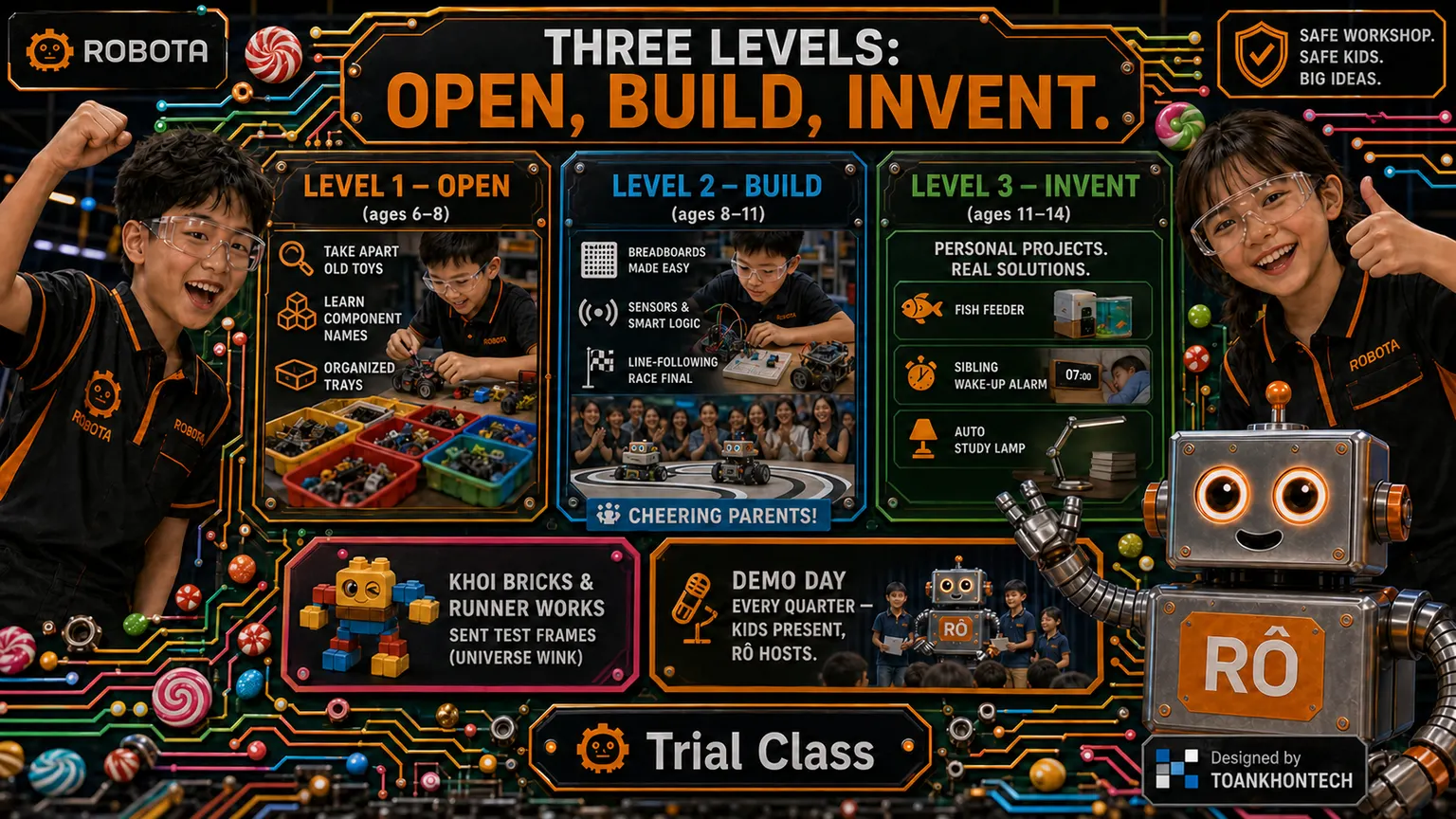
Three levels: open, build, invent.
Level 1 reads components, Level 2 connects mechanisms, and Level 3 defines a problem. Each level has a reference output without requiring every child to make the same object.
The pathway supports search and consultation by age and ability without turning learning into an endless badge tree.
Progress is measured by the quality of questions, not robot complexity alone.
Design language
Recognise ROBOTA — XƯỞNG STEM CHO TRẺ before the logo has to appear.
The design language follows a product showcase treatment, the concept palette, and its native image rhythm. The goal is not novelty in every section but a small set of rules strong enough to support new content.
- 01
Contrast with a job
Accent colour is reserved for attention and primary action; background, type, and imagery stay stable so ROBOTA — XƯỞNG STEM CHO TRẺ never becomes noise.
- 02
An industry-specific rhythm
Image ratio, paragraph length, and headline placement follow how people actually explore an education programme website, not a universal portfolio template.
- 03
Evidence before invitation
Student work, pathways, mentors, and feedback arrives before the CTA, making action a reasonable consequence of the story rather than an interruption.
Colour system
#000818
#482810
#202830
#002860
#887870
Colours come directly from ROBOTA — XƯỞNG STEM CHO TRẺ's art direction. Production should validate WCAG contrast for copy, interaction states, and charts instead of assigning every colour equal weight.
Production direction
Turn the concept into a system with content, data, and clear ownership.
The visual design is an opening hypothesis. A live version must be tested with real content, real behaviour, and the technical constraints of the team that will maintain it.
- 01
Inventory content and data
Identify the source, update cadence, and approver for student work, pathways, mentors, and feedback before finalising page architecture.
- 02
Prototype the primary flow
Test “Choose a programme and book a trial class” on real devices, including missing data, failure, and interrupted-return states.
- 03
Performance and access
Serve images at display size, preserve semantic HTML, support keyboard use, and respect reduced motion so the experience does not require powerful hardware.
- 04
Measure what matters
Track programme views, trial bookings, and completed enrolment profiles, exclude internal traffic, and agree event definitions before interpreting results.
Frequently asked questions
Questions to resolve before producing ROBOTA — XƯỞNG STEM CHO TRẺ.
- Who is ROBOTA — XƯỞNG STEM CHO TRẺ designed for?
- Curious students and parents looking for visible learning proof. Every layout decision serves one primary action: choose a programme and book a trial class.
- Why does this detail page differ from the other concepts?
- The product showcase treatment follows how people explore an education programme website, its information density, and its particular visual language.
- Could the concept become a real website?
- Yes, after replacing assumptions with real content, data, legal requirements, and the organisation's “Choose a programme and book a trial class” process.
- How should effectiveness be measured?
- A useful starting set is programme views, trial bookings, and completed enrolment profiles; final targets must follow the real operating model.
Continue exploring
More concepts in the field, each with a different answer.
From concept to product
Have an idea that needs to become a real website?
ToanKhonTech can shape positioning, content architecture, conversion flow, and an interface system for your actual context—without copying a concept wholesale.