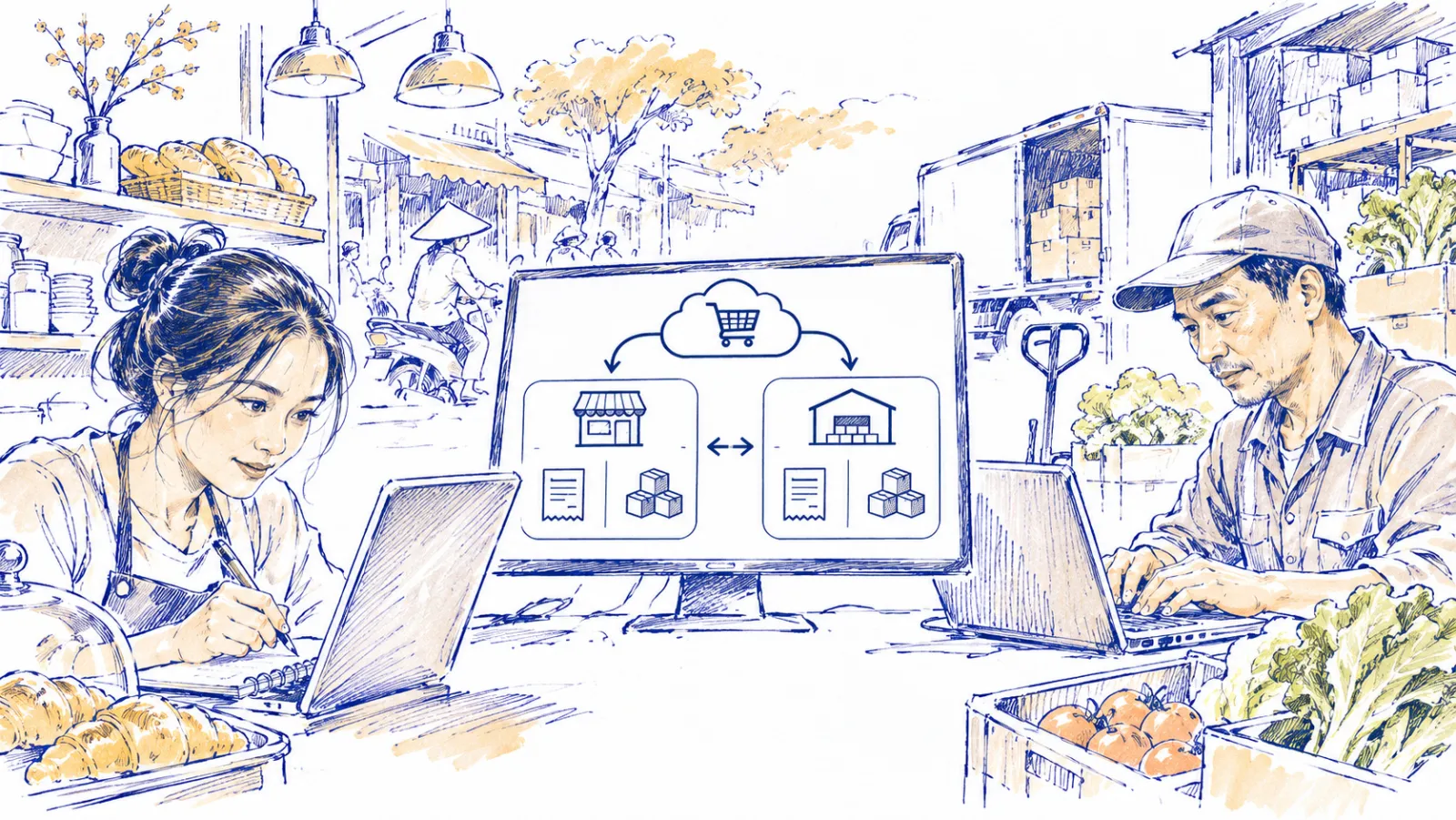
When a company expands across regional distribution networks, multiple subsidiaries, or partner-facing SaaS portals, the hardest engineering challenge is rarely the form UI. The critical factor for an ERP, DMS, or WMS platform is its multi-tenant architecture: keeping inventory ledgers, receivables, and orders strictly isolated per organization on a shared codebase while enforcing granular role permissions and preventing heavy reports from stalling daily warehouse shifts.
Relying on ad-hoc company_id filters written manually inside application queries leaves a brittle gap. A single missing WHERE clause in an end-of-month reconciliation export is enough to expose one customer's pricing tier or shipment manifest to another tenant.
Before creating the first schema migration, engineering teams need to lock in the storage isolation model. In real-world enterprise systems builds, two patterns dominate: a shared relational database protected by Row Level Security (RLS) in PostgreSQL (as documented by Supabase), or dedicated databases per tenant (increasingly practical on edge SQL runtimes such as Cloudflare D1).
| Engineering dimension | Shared DB + Row Level Security | Database-per-tenant (e.g., per-tenant D1) |
|---|
| Data isolation boundary | Logical isolation enforced by SQL policy | Physical separation per database file or instance |
| Schema migration effort | Low, single migration pass across one schema | Higher, requires orchestrated rollout across every DB |
| Cross-tenant reporting | Fast via direct SQL aggregation | Requires a separate aggregation pipeline |
| Noisy-neighbor exposure | Shared CPU and I/O unless throttled carefully | Lower, heavy workloads stay bounded to one DB |
| Best fit | DMS networks and retail chains with hundreds of branches | Large enterprises needing isolated backups and encryption keys |
As documented in Supabase's Postgres Row Level Security guide, RLS attaches row-level predicates directly to database tables so the SQL engine filters every read and write according to session context. By contrast, Cloudflare D1 makes spinning up isolated SQLite-backed databases per tenant viable at the edge, containing blast radius and heavy report load within each tenant boundary in exchange for automated provisioning and multi-database migration tooling.
Propagating tenant context and enforcing scoped RBAC
A recurring vulnerability in custom business portals is accepting tenant_id directly from a JSON request body or URL query string. A forged API call or stale frontend cache can easily route an invoice mutation to the wrong entity. A resilient pipeline keeps tenant identity locked from the network edge down to storage:
- 01Verify identity at the edge runtime: During login, the signed JWT or session verified inside Cloudflare Workers must bind the authenticated user ID, authorized tenant list, and role claims. Edge middleware must reject or ignore any client-supplied
tenant_id outside those verified claims. - 02Inject session-scoped context into SQL transactions: In a shared database setup, immediately set a transaction-local variable (such as
SET LOCAL app.current_tenant_id = '...' in PostgreSQL) after acquiring a connection from the pool, and let RLS policies enforce that variable before returning any row. - 03Pair RBAC actions with operational scopes: ERP and WMS workflows need more than coarse titles such as Accountant or Warehouse Clerk. A DMS sales representative may only approve orders within assigned territory routes, while a warehouse operator can only post stock transfers for specific depot codes. Separate action permissions (create, approve, void) from data scopes (warehouse, branch, sales region).
- 04Maintain an immutable audit trail: Every cost-basis adjustment, stock-out cancellation, or credit-limit override must write an audit record capturing
tenant_id, actor_id, client IP, UTC timestamp, and before/after snapshots. Restrict the application database role to INSERT only on audit tables, revoking UPDATE and DELETE.
In a multi-tenant WMS or DMS serving dozens of active companies, the noisy-neighbor problem strikes when one large tenant exports an annual stock movement ledger, saturating database CPU and freezing barcode picking screens for every other tenant on the cluster.
To prevent cascading stalls, ToanKhonTech enforces four operational safeguards:
- Lead every composite index with `tenant_id`: High-volume transactional tables (
orders, stock_movements, invoices) must structure B-Tree indexes as (tenant_id, created_at DESC) or (tenant_id, status, warehouse_id). Putting tenant_id first allows the query planner to narrow scans immediately to a single tenant slice. - Split analytical reads from transactional writes: Heavy receivables aging reports and multi-month inventory valuations belong on read replicas or asynchronous background rollup jobs, keeping the primary write path responsive for live order capture and dispatch.
- Apply per-tenant rate limits and SQL timeouts: Enforce per-tenant request quotas at the Workers edge layer alongside strict database
statement_timeout bounds so runaway queries fail fast instead of exhausting the connection pool. - Isolate object storage prefixes and signed URLs: Store PDF invoices, DMS shelf photos, and audit attachments under tenant-prefixed paths, verifying tenant ownership before minting short-lived pre-signed download links.
Scope and engineering limitations
The architectural practices in this guide synthesize official vendor documentation from Supabase (Postgres Row Level Security), Cloudflare D1, and Cloudflare Workers Runtime alongside ToanKhonTech's enterprise software delivery experience. They do not represent fixed throughput benchmarks on any specific hardware profile or cloud tier.
Before committing to a production topology, engineering teams should benchmark their chosen isolation model against realistic row counts, peak shift-closing write bursts, and automated migration workflows tailored to their target tenant count and compliance rules.