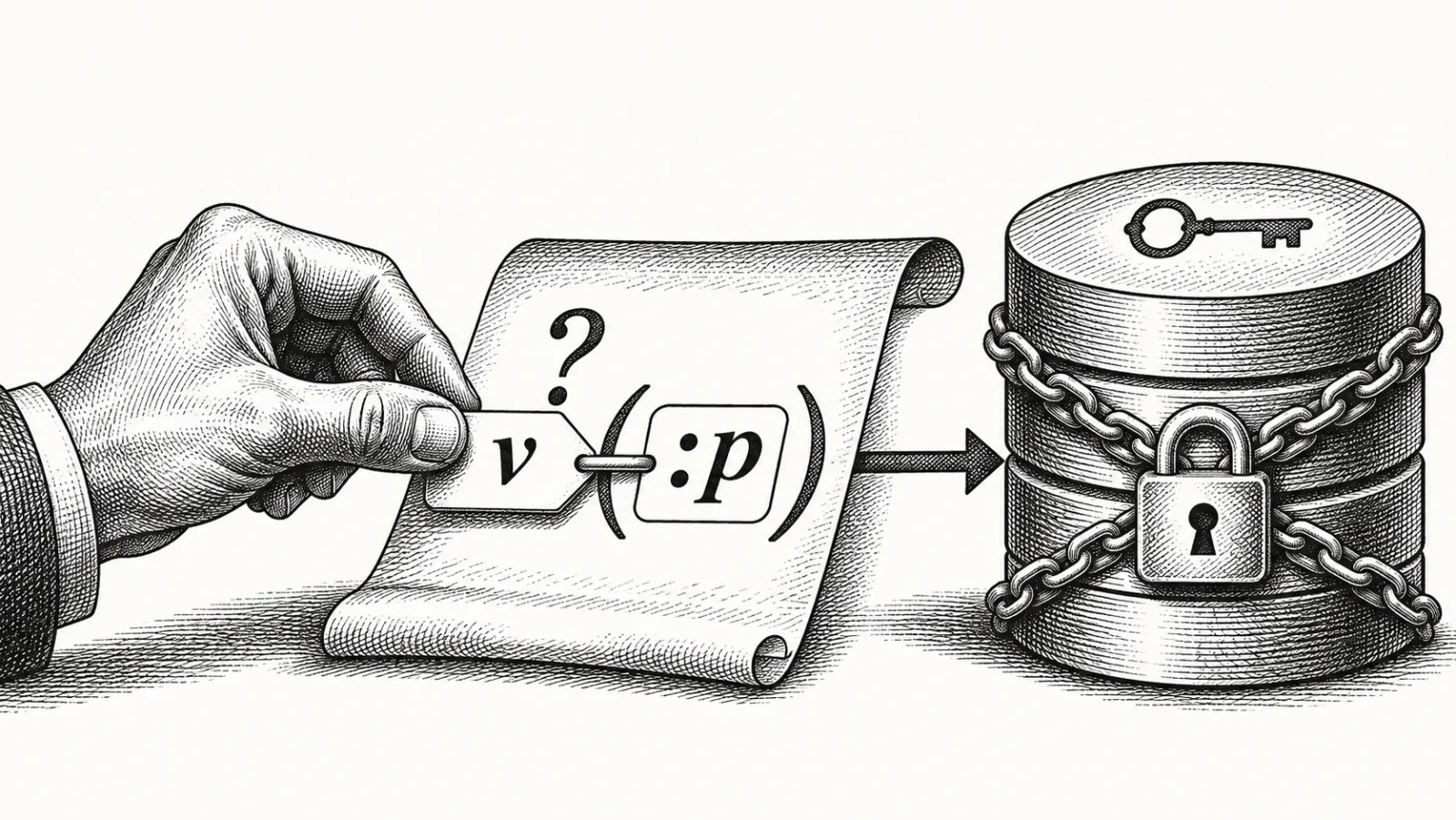
In most enterprise data breaches, attackers do not break advanced cryptography. They exploit foundational engineering gaps: an endpoint concatenates untrusted input into SQL, a web app connects as database superuser, or an error handler dumps sensitive columns straight into debug logs. When customer profiles, invoices, and session tokens share one relational cluster, a single weakness at the query or transport layer can expose the entire dataset.
Effective database security relies on independent defensive layers: eliminate query-level injection, restrict what each service role can access, encrypt data in transit and at rest, and keep sensitive fields out of diagnostic telemetry.
1. Parameterized queries and allowlists against SQL injection
According to the OWASP Cheat Sheet: SQL Injection Prevention, the primary defense against SQL injection is parameterized queries (prepared statements). Instead of concatenating strings, the application sends the SQL template separately from the bound parameter array. Because the database parser compiles the statement beforehand, user input is treated strictly as scalar data and can never alter query syntax.
Teams often rely on an ORM yet leave raw SQL string interpolation in place for complex reports or multi-filter search. The example below contrasts a vulnerable filter with a safe parameterized query:
-- Vulnerable: direct string concatenation lets input alter SQL syntax
SELECT id, total_amount, status FROM orders
-- Safe: SQL structure is compiled separately from bound parameters ($1, $2) PREPARE get_orders_by_email (integer, text) AS SELECT id, total_amount, status FROM orders WHERE tenant_id = $1 AND customer_email = $2; ```
Bind parameters only protect literal values; engines do not accept placeholders for table names, column names, or sort directions (ASC, DESC). For dynamic sorting such as ?sort=created_at&dir=desc, never interpolate client strings into ORDER BY. Map requested keys through a fixed server-side allowlist that resolves known identifiers to constant SQL tokens, and validate types (UUIDs, integer bounds, max lengths) before hitting the driver.
2. Least-privilege service roles and row-level boundaries
Even with prepared statements everywhere, authorization flaws or compromised dependencies can still issue unintended queries. A web runtime must never connect as postgres, superuser, or the schema-owning migration account.
A resilient permission model splits database access across three distinct roles:
- 01Migration role (`db_migrator`): reserved for CI/CD schema pipelines (
CREATE, ALTER, DROP), with credentials never mounted into live web containers. - 02Application runtime role (`app_runtime`): granted only
SELECT, INSERT, UPDATE, and DELETE on specific tables that require hard deletion. Revoke default privileges on SCHEMA public and keep SUPERUSER, CREATEDB, CREATEROLE, and BYPASSRLS disabled. - 03Read-only reporting role (`bi_reader`): limited to
SELECT on curated views that exclude secrets, routed to a dedicated read replica.
For multi-tenant SaaS and internal portals, PostgreSQL Docs: Row Security Policies enforce isolation inside the database engine. Enabling ENABLE ROW LEVEL SECURITY alongside FORCE ROW LEVEL SECURITY requires every query from app_runtime to satisfy USING and WITH CHECK policies bound to a transaction-scoped variable such as SET LOCAL app.current_tenant_id = '...'. If a complex join omits WHERE tenant_id = ..., PostgreSQL blocks cross-tenant rows automatically.
3. Verified TLS, encryption at rest, and log redaction
Database records often leak through three overlooked channels: unencrypted internal links, exposed snapshots or disks, and verbose operational logs capturing bound SQL parameters.
| Security layer | Recommended implementation | Primary risk if omitted | Operational check |
|---|
| Transport (TLS) | Enforce sslmode=verify-full with verified certs | Credential sniffing or MITM on internal subnets | Rotate internal CA certs early; avoid disable |
| Storage and backups | AES-256 volume encryption plus encrypted backups | Full exposure if snapshots or buckets leak | Keep KMS keys separate from backup storage |
| Column-level encryption | Encrypt API tokens and IDs in app code via KMS | Plaintext visible to DB admins or raw dumps | Add keyed HMAC columns if exact lookup is needed |
| Query and error logs | Disable parameter logging; scrub sensitive fields | Passwords, OTPs, and PII stored in log aggregators | Audit log_statement, slow query logs, and traces |
When building enterprise systems and web platforms, ToanKhonTech enforces parameter redaction directly in ORM loggers and error middleware. Leaving SQL DEBUG mode enabled or serializing full error.parameters on constraint failures quickly pushes emails, phone numbers, and tokens into shared log stores. Production logs should capture only normalized SQL templates, error codes, latency, and a request_id.
Scope, caveats, and engineering boundaries
The SQL injection controls and row-level isolation patterns in this guide reference the official OWASP SQL Injection Prevention Cheat Sheet and PostgreSQL Row Security Policies documentation. The role-separation model, sslmode=verify-full setup, KMS column encryption workflow, and log-redaction practices reflect ToanKhonTech's engineering practice rather than a vulnerability report against any database vendor.
Operational trade-offs also apply. Behind a transaction pooler like PgBouncer, PostgreSQL RLS context must be set with SET LOCAL inside an explicit transaction so tenant context never leaks between pooled requests. Column-level encryption also adds CPU overhead and disables native SQL sorting or substring matching (LIKE '%...%'), requiring deliberate index design before rollout.