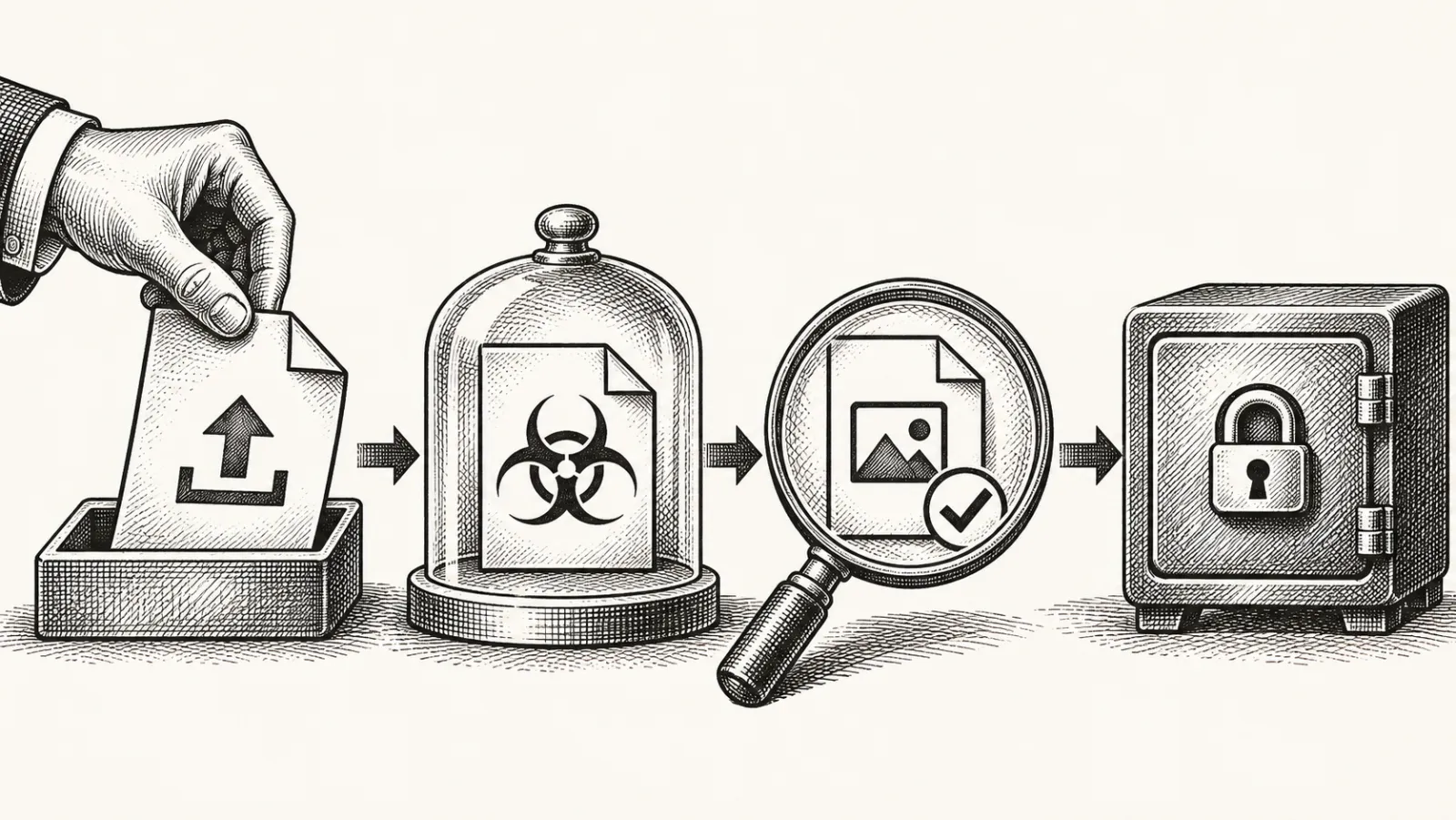
Nearly every enterprise web application accepts user-uploaded files such as candidate CVs (PDF), electronic invoices, payment receipts, or profile avatars. If the backend only checks extensions like .pdf or .jpg or trusts the browser-supplied Content-Type header, attackers can disguise HTML or SVG files carrying JavaScript to trigger Stored XSS, submit oversized payloads to exhaust server memory (DoS), or guess public paths to access confidential records. Moving ingestion and storage onto an isolated Cloudflare R2 or Amazon S3 architecture closes these attack surfaces at the infrastructure layer.
Under the OWASP File Upload Cheat Sheet, filenames and MIME Content-Type headers are fully client-controlled inputs that any HTTP proxy can modify. To determine the true payload format, the server or a post-upload worker must read the leading binary bytes (magic bytes) of the stream and match them against a strict allowlist.
Specifically, a standard PNG always begins with hex bytes 89 50 4E 47 0D 0A 1A 0A, JPEG files open with FF D8 FF, and valid PDFs start with %PDF- (25 50 44 46 2D). For public avatars, allow only safe raster formats such as JPEG, PNG, or WebP, and exclude SVG because SVG is an XML document that can embed <script> tags and DOM event handlers. After validating magic bytes, decode and re-encode uploaded images into fresh WebP or JPEG files to strip sensitive EXIF metadata (such as GPS coordinates and device tags) and neutralize trailing polyglot payloads.
Alongside binary checks, enforce size limits across three layers:
- 01Edge and Reverse Proxy Layer: Configure body caps (such as
client_max_body_size 5m in Nginx) to reject oversized requests before buffering them into application memory. - 02Application Policy Layer: Set explicit business ceilings, such as 2 MB for user avatars and 10 MB for PDF resumes or invoices.
- 03Random Object Keys: Never build storage paths from user-supplied filenames, preventing path traversal (
../../). Generate random UUIDv4 or ULID keys paired with a verified extension (such as avatars/9f3c2e10-84ab-4c1b-9a21-6e11d8a4e0c2.webp) and store the sanitized display name only in database metadata.
Origin Isolation on R2/S3 and HTTP Response Headers
Saving user uploads into a static directory under the main web app origin (for example app.company.com/uploads/file.html) is a critical design flaw. Sharing an origin allows any script that slips past filters to execute inside the primary domain's security context, reading session state and calling internal APIs on the victim's behalf.
The standard defense moves all uploaded assets onto Cloudflare R2 or Amazon S3, served exclusively through a separate cookieless subdomain (such as files.company-assets.com). Even for public CDN avatars, origin separation ensures browsers isolate localStorage, HttpOnly cookies, and same-origin API permissions from user-supplied files.
When delivering stored files, enforce two protective HTTP headers:
Content-Disposition: attachment; filename="candidate-cv.pdf": Forces browsers to download documents or invoices rather than rendering active content inline in the current tab.X-Content-Type-Options: nosniff: Blocks MIME sniffing when plain text or binary data is disguised as HTML.
For buckets holding private CVs or accounting records, disable all public access (including default r2.dev subdomains) and remove ListObjects permissions from client-facing credentials.
Short-Lived Signed URLs for Private Files and Direct Uploads
To keep large transfers off API servers, apps often issue Presigned PUT URLs so browsers upload directly to R2 or S3. Without signed constraints, however, a client can still upload a 500 MB file despite a 5 MB UI limit.
| Pipeline Stage | Mandatory Control | Recommended Configuration | Threat Mitigated |
|---|
Direct Upload (Presigned PUT) | Lock size, MIME type, and URL expiry | 60 - 120s TTL; bind Content-Length and Content-Type | Oversized payloads, stale upload URL replay |
| Post-Upload Verification | Check magic bytes, re-encode images, assign UUID | Worker inspects binary header before activating record | Spoofed MIME types, SVG/HTML XSS, EXIF leaks |
| Storage Isolation | Host on separate R2/S3 origin; disable listing | Cookieless asset subdomain; disable public bucket read | Same-origin Stored XSS, bucket key enumeration |
Private Access (Signed GET) | Verify ownership on backend before signing | 60 - 300s TTL; enforce Content-Disposition: attachment | Leaked static CV/invoice links, IDOR reads |
For private files (resumes, financial invoices), never embed static links in HTML or JSON payloads. On every view or download request, the backend must verify ownership (tenant_id, user_id, or RBAC role) before issuing a short-lived Signed GET URL (60 to 300 seconds) via S3v4 signing, paired with Cache-Control: private, no-store so intermediate proxies never cache temporary access URLs.
Designing format validation, origin separation, and signed URL lifecycles upfront prevents costly leaks as platforms scale. Teams building recruitment portals, ERPs, or commerce platforms can review how ToanKhonTech integrates these controls in our enterprise web development services.
Scope, Caveats, and Technical Boundaries
This guide synthesizes public recommendations from the OWASP File Upload Cheat Sheet and Cloudflare R2 documentation alongside ToanKhonTech's engineering practices. ToanKhonTech makes no claim of discovering new vendor vulnerabilities in Cloudflare R2 or Amazon S3.
Magic-byte inspection, origin isolation, and signed URLs form a foundational defense, not a replacement for dedicated antivirus or Content Disarm and Reconstruction (CDR) scanning on macro-enabled Office files (.docx, .xlsx) or scripted PDFs. Systems handling regulated financial or healthcare documents should add a background malware scanning queue before staff open uploads, backed by server-side encryption and audit logs.