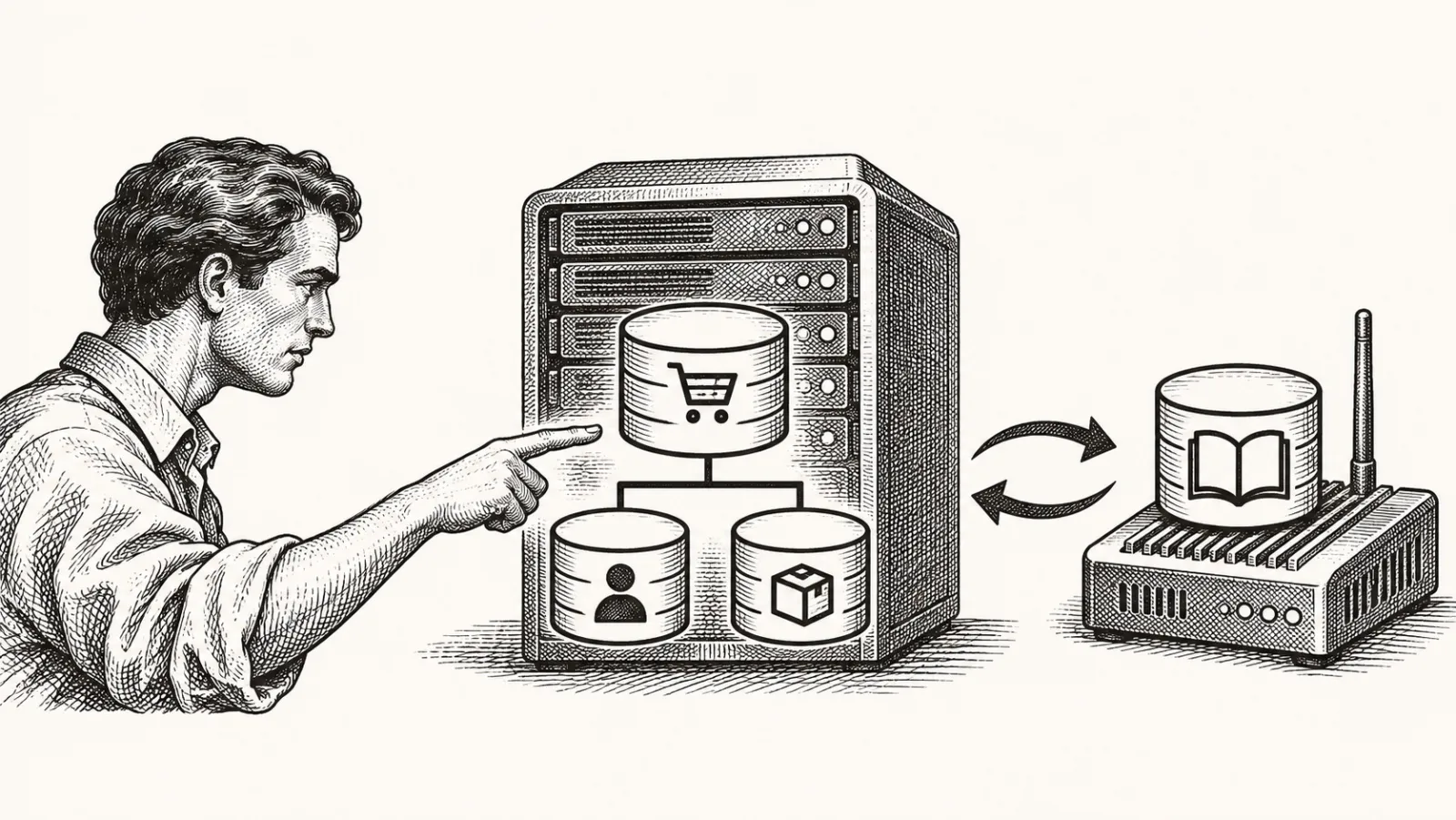
Selecting a database for a web product or SaaS platform shapes both page-load latency and monthly cloud spend. Many engineering teams default to PostgreSQL on day one, only to find edge-rendered pages still feel sluggish when every request crosses sub-oceanic links back to a single regional cluster. Conversely, moving transactional workloads onto Cloudflare D1 without accounting for SQLite's sequential write model creates write contention once concurrent users update shared tables.
Read-Write Patterns and Core Storage Architecture
The foundational difference lies in concurrency control and connectivity. PostgreSQL, whether self-hosted or managed via Supabase, uses Multi-Version Concurrency Control (MVCC). Concurrent read and write transactions run across tables with row-level locking, supporting sustained write traffic, multi-statement transactions, and extensions without locking the whole database. However, serverless and edge callers connecting over TCP incur handshake overhead and connection limits, typically requiring a pooler near the primary instance.
According to official Cloudflare D1 documentation, D1 runs serverless SQLite bound directly to Cloudflare Workers with no external connection strings or poolers. Each D1 database processes write queries sequentially through a single-threaded model at its primary node. For read-heavy workloads such as product catalogs, editorial sites, or public configuration lookups, D1 distributes global read replicas paired with the D1 Sessions API (db.withSession()), using session bookmarks to maintain sequential consistency. If one D1 database absorbs thousands of concurrent INSERT or UPDATE mutations per second, sequential write queuing becomes a bottleneck unless data is sharded across per-tenant or regional D1 instances.
| Architectural Dimension | PostgreSQL (Managed / Supabase) | Cloudflare D1 (Edge SQLite) |
|---|
| Concurrency & Connectivity | MVCC row-level writes; needs pooling from serverless tiers | Serverless SQLite via native Workers bindings |
| Write-Heavy Scaling | Parallel concurrent writes across tables | Sequential single-threaded writes per database |
| Global Read Latency | Fast near primary region; needs read replicas for multi-region | Global read replicas with Sessions API consistency |
| Relational Depth & Limits | Complex JOINs, CTEs, window functions, JSONB, extensions | Standard SQLite; 2 MB max row/BLOB, 10 GB max DB (paid tier) |
| Access Control | Native Row Level Security (CREATE POLICY) | Enforced in Worker/application layer before SQL execution |
| Backup & Recovery | Scheduled snapshots and PITR depending on plan tier | Automatic Time Travel (7 days free, 30 days paid) |
Relational Complexity, Row Level Security, and Time Travel
For multi-tenant SaaS products, financial ledgers, or internal enterprise portals, data isolation guarantees matter as much as speed. PostgreSQL provides mature built-in Row Level Security (RLS). As documented in the official PostgreSQL Row Security Policies reference, running ALTER TABLE ... ENABLE ROW LEVEL SECURITY enforces a default-deny posture until explicit policies are attached (aside from table owners unless FORCE ROW LEVEL SECURITY is set, or roles holding BYPASSRLS). Engineers define USING expressions to filter existing rows on reads, updates, and deletes, alongside WITH CHECK expressions to validate new or modified rows. Permissive policies combine with OR, while AS RESTRICTIVE policies enforce mandatory AND conditions, keeping tenant boundaries inside the storage engine even if an API handler omits a filter clause.
Cloudflare D1 does not provide database-native per-user row security policies, so authorization checks must be strictly enforced inside Cloudflare Workers before queries execute. On the operational side, D1 includes always-on Time Travel without manual backup scripts: teams can restore a database to any specific minute within a 7-day window on the Free plan or a 30-day window on the Workers Paid plan (capped at 10 restores per 10 minutes per database). In managed PostgreSQL environments, continuous Point-in-Time Recovery (PITR) generally requires higher-tier paid plans or explicit Write-Ahead Log archiving.
Cost Modeling and Practical Selection Checklist
Billing models reflect each platform's underlying runtime. Managed PostgreSQL charges primarily for provisioned compute (vCPU, RAM), disk storage, and replica nodes, creating predictable baseline spend even during quiet overnight hours. Cloudflare D1 follows a scale-to-zero, usage-based pricing model metered across rows read, rows written, and stored gigabytes. One critical optimization nuance on D1 is that "rows read" counts every row scanned by the query planner rather than only rows returned; an unindexed query performing full table scans can inflate read volume rapidly.
Before finalizing an architecture within our cloud and DevOps engineering services, teams should walk through a four-point evaluation checklist:
- 01Audit your read-to-write ratio and contention points: If reads exceed 80% of traffic and writes can be scoped per user or tenant, D1 removes idle compute costs and cuts edge latency. If concurrent users frequently mutate shared tables, choose PostgreSQL.
- 02Verify multi-tenant security and analytical SQL needs: Workloads requiring database-level RLS, multi-table analytical JOINs, indexed JSONB documents, or specialized Postgres extensions belong on PostgreSQL.
- 03Check dataset size and query ceilings: Cloudflare D1 caps individual databases at 500 MB on the Free plan and 10 GB on the Paid plan, with a 30-second query duration limit. Datasets spanning hundreds of gigabytes require PostgreSQL or explicit multi-database sharding.
- 04Evaluate a hybrid topology: High-traffic global apps often place session tokens, edge routing metadata, and read-heavy regional lookups on D1 while keeping authoritative billing, ERP workflows, and relational writes inside PostgreSQL.
Scope, Caveats, and Engineering Limitations
This comparison synthesizes documented platform architecture from PostgreSQL's Row Security Policies manual and Cloudflare D1's official documentation together with ToanKhonTech's engineering assessment; it does not report proprietary benchmark runs on dedicated hardware. Platform limits, replication behavior, and per-million-row pricing tiers remain subject to vendor updates. Before committing to a migration or new build, engineering teams should model expected query scan counts, review SQL indexing plans, and map the geographic distribution of both readers and writers.