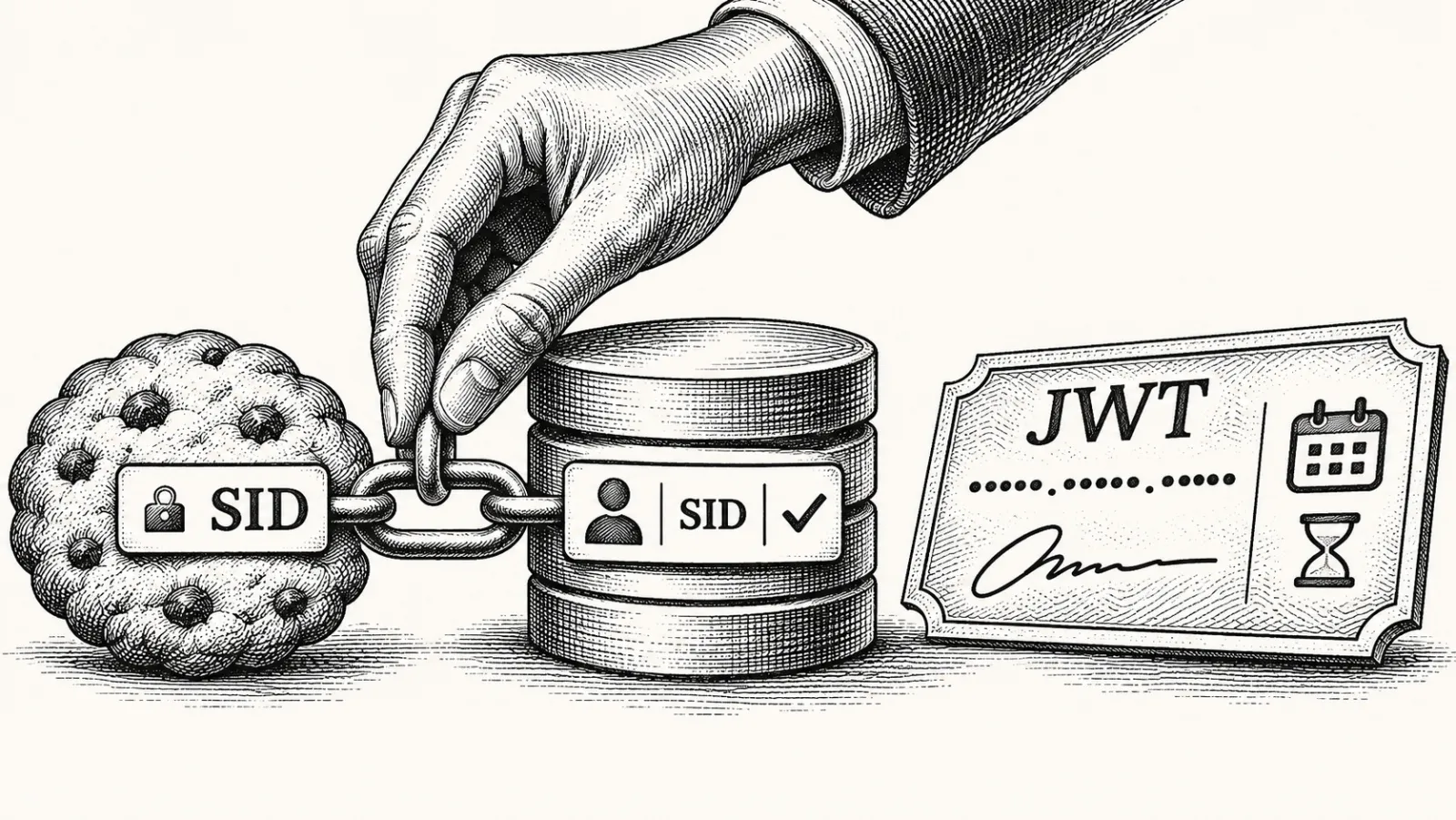
When building single-page web applications, customer portals, or admin consoles, many teams default to returning a JWT pair and writing it to localStorage for quick Authorization: Bearer header injection. While convenient early on, this pattern creates real operational risk: a single Cross-Site Scripting (XSS) flaw in a rich-text editor or third-party script can turn into silent, multi-day account takeover.
Moving to HttpOnly cookies often raises concerns about Cross-Site Request Forgery (CSRF) or authenticating microservices. Understanding each mechanism's browser boundary lets teams choose session storage based on threat reality rather than short-term convenience.
Per MDN Web Docs on HTTP cookies, localStorage and sessionStorage are readable by any JavaScript running on the same origin. First-party code, analytics tags, chat widgets, or a compromised npm dependency can all invoke localStorage.getItem(...). If an admin panel has an XSS bug, an attacker can exfiltrate the raw JWT and replay requests from an external IP until exp expires, even after the victim closes the tab.
Placing the session credential in an HttpOnly, Secure cookie narrows that blast radius:
HttpOnly blocks JavaScript from reading the value via document.cookie, preventing raw token extraction for offline replay.Secure forces transmission only over encrypted HTTPS links, avoiding exposure on untrusted networks.- The
__Host- prefix (with Secure, Path=/, and no Domain attribute) binds the cookie to the exact host origin, blocking cookie tossing from sibling subdomains.
To be realistic, HttpOnly does not make an app immune to XSS. An active script inside an open tab can still call fetch because browsers attach cookies automatically. Even so, keeping credentials out of JavaScript stops persistent offline replay, giving Content Security Policy (CSP) controls and server-side revocation time to contain the breach.
2. CSRF protection, SameSite behavior, and subdomain boundaries
Teams often avoid cookies due to CSRF, since browsers auto-attach cookies to target domains while HTML forms do not auto-attach Authorization: Bearer headers. Browsers mitigate much of this surface via SameSite when configured properly:
SameSite=Strict: withholds cookies on all cross-site requests, including link clicks. Ideal for internal admin consoles, though it can disrupt email or external SSO redirects.SameSite=Lax: blocks cookies on cross-site state-changing calls (POST, PUT, DELETE, fetch) while keeping top-level GET navigations smooth. It fits most web apps.SameSite=None; Secure: reserved for legitimate cross-domain embeds like payment iframes and constrained by third-party cookie restrictions.
Avoid treating SameSite=Lax as complete CSRF immunity. Browsers define "same-site" by registrable domain (eTLD+1 and scheme), not exact origin. If blog.example.com shares a root domain with app.example.com, an XSS flaw on the blog still counts as same-site against app. During custom web application development for sensitive portals, ToanKhonTech pairs SameSite=Lax (or Strict) with explicit intent checks: custom-header CSRF tokens (X-CSRF-Token), gateway Sec-Fetch-Site validation, and strict Access-Control-Allow-Origin allowlists instead of wildcards when Access-Control-Allow-Credentials: true is set.
3. Instant revocation, token rotation, and practical comparison
According to the OWASP Session Management Cheat Sheet, applications must revoke sessions immediately on logout, password reset, MFA changes, or account suspension. Stateless JWTs in localStorage struggle here: while the signature is valid and exp remains in the future, backends cannot invalidate a leaked JWT without checking a Redis denylist or token version on every request, removing the stateless advantage.
| Technical Criterion | Opaque Cookie (HttpOnly, Secure, SameSite) | JWT in localStorage | BFF / In-Memory Access Token + Rotating Refresh Cookie |
|---|
| XSS token extraction | Low: JS cannot read the cookie | High: readable via localStorage | Low: refresh credential stays in HttpOnly cookie |
| CSRF exposure | Moderate: needs SameSite + CSRF token | Low: header not auto-sent cross-site | Moderate: /refresh must enforce CSRF checks |
| Instant revocation | Yes: deleting Redis key acts immediately | Hard: wait for exp or add denylist | Yes: revoking session or token family stops renewal |
| SSR compatibility | Native on initial document request | Poor: waits for JS hydration |
For microservice architectures, a Backend-for-Frontend (BFF) proxy or an in-memory access token (5 to 10 minutes, never saved in localStorage) paired with a rotating HttpOnly refresh cookie offers strong balance. Each /auth/refresh call issues a new refresh token and retires the previous one. Replaying a spent refresh token triggers immediate revocation of the entire token family and forces re-login. Servers should also enforce both idle timeouts and absolute session lifetimes.
Scope and technical limitations
Cookie attributes and session rules cited here follow the OWASP Session Management Cheat Sheet and MDN Web Docs HTTP cookies documentation. The comparison table, __Host- hardening, BFF exchange pattern, and refresh reuse detection reflect ToanKhonTech's engineering practices rather than security audits of third-party products.
Session storage alone never secures an entire application. Even with HttpOnly cookies, in-session abuse via XSS remains possible without output encoding, CSP rules, and per-endpoint authorization checks. Cookie workflows also do not fit native mobile apps or machine-to-machine APIs; those clients should use OAuth 2.0 Authorization Code with PKCE backed by OS Keychain or Keystore storage.