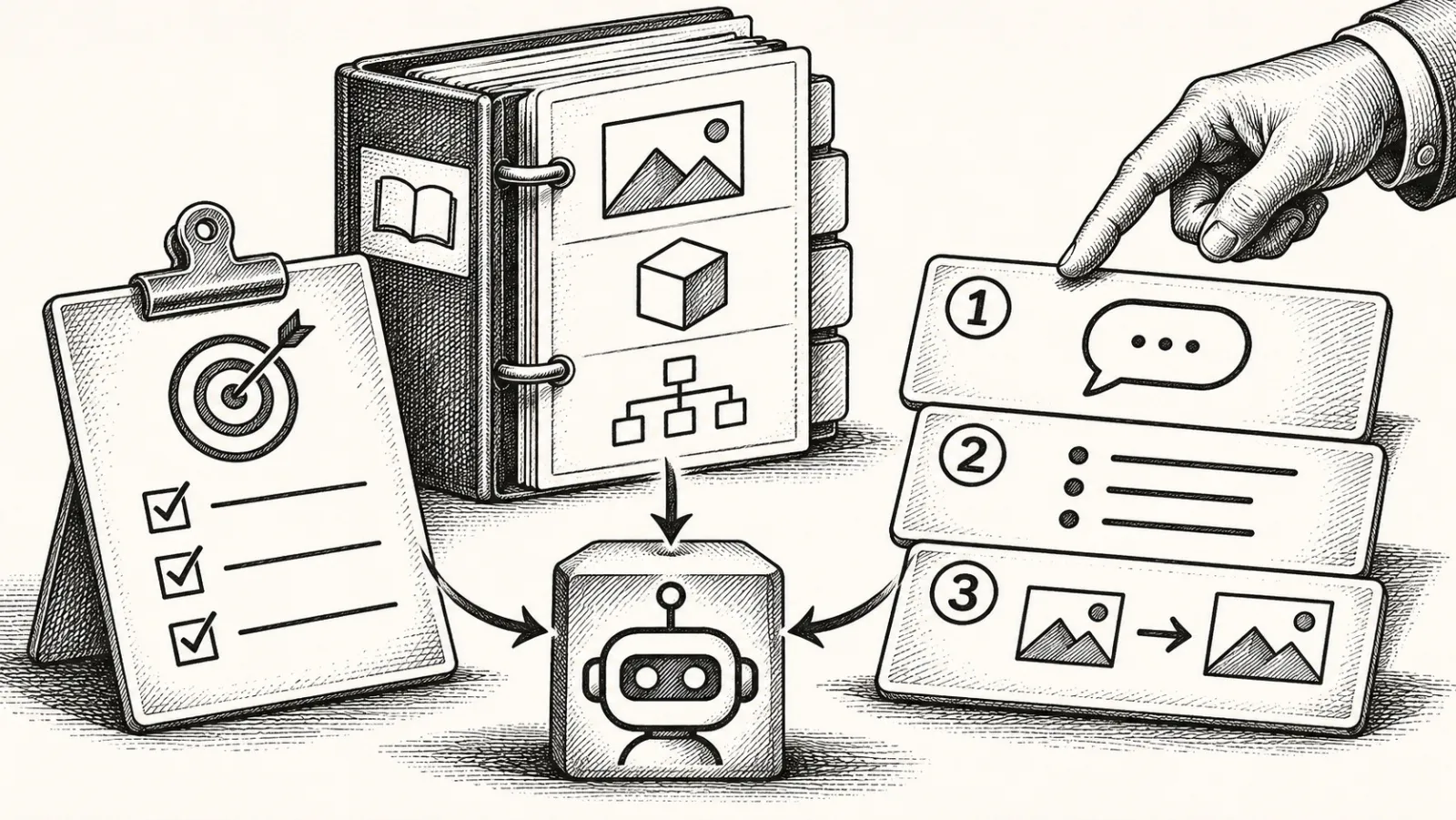
Many product and engineering teams share a familiar reflex when deploying LLMs internally: the moment a model misses company terminology, gives verbose replies, or misstates an internal rule, someone proposes fine-tuning. Weeks go into exporting logs, paying domain specialists to label thousands of examples, and running GPU training jobs. In production, the new checkpoint often disappoints: it still fabricates numbers when pricing changes, and it turns into maintenance debt as soon as a vendor releases a stronger base model. Choosing between Prompt Engineering, Retrieval-Augmented Generation (RAG), and Fine-Tuning is not about picking the most complex tool. It is an architectural decision separating runtime instructions, mutable facts, and learned output behavior.
Supervised fine-tuning updates neural weights across curated input-output pairs. That mechanism excels at locking in a brand voice, enforcing compliance refusal rules, improving tool-calling habits, or stabilizing rigid output schemas without repeating long few-shot examples in every API call. OpenAI's official Fine-tuning documentation explicitly recommends exhausting prompt engineering, few-shot prompting, and retrieval tools before training, because fine-tuning adapts *how* a model responds rather than acting as a reliable factual store.
Using model weights as an enterprise database creates structural failures. Parameters cannot be cleanly edited or deleted per record. When a discount tier or HR policy changes next week, older patterns stay embedded across weights and can surface as confident hallucinations. Weight-encoded knowledge also provides no native pointer back to source documents, leaving legal and audit teams without verifiable citations.
RAG and Contextual Retrieval for Mutable Enterprise Knowledge
When failures stem from missing private data or fast-changing policies, RAG solves the root cause directly. The reasoning engine stays stateless and untouched while proprietary knowledge lives in an external index with access controls, timestamps, and metadata. Updating a policy file only requires re-indexing the changed document, reflecting revisions within seconds alongside verifiable source excerpts.
Naive RAG pipelines, which split files into fixed-size chunks and index raw vectors, still struggle on dense enterprise documents. An isolated chunk stating "revenue grew 3% last quarter" or "liability is capped at 2 million USD" loses the document header naming the subsidiary, fiscal period, or contract, causing both semantic and keyword search to miss it.
In Introducing Contextual Retrieval, Anthropic detailed a practical solution: using an LLM to prepend a brief document-level context note to each chunk before generating embeddings (Contextual Embeddings) and keyword indexes (Contextual BM25). In Anthropic's evaluations, combining Contextual Embeddings and Contextual BM25 reduced retrieval failure rates by 49%, and adding a reranking step cut retrieval failures by 67%. Improving retrieval precision yields far higher factual reliability than retraining weights.
The Hidden Costs of Fine-Tuning: Labeling, Evals, and Upgrade Drift
Even when behavioral control is the true goal, compute bills represent a small slice of fine-tuning's total cost. Three operational taxes dominate:
- 01Data curation and labeling cost: Reliable training sets require domain experts to write, review, and deduplicate hundreds to thousands of examples, then re-clean them whenever business rules shift.
- 02Evaluation harness maintenance: Without automated regression suites covering both target tasks and general reasoning, narrow fine-tuning can quietly degrade instruction following on adjacent edge cases.
- 03Model upgrade drift and migration tax: Frontier base models advance rapidly in reasoning, context stability, and token pricing. A fine-tuned checkpoint locks your stack to an older snapshot. When that snapshot is deprecated or outpaced, teams must re-run evals, reformat training pairs, and retrain from scratch.
Architectural Decision Matrix and Three-Step Escalation Ladder
| Evaluation Dimension | Prompt Engineering | RAG (Contextual Retrieval) | Fine-Tuning |
|---|
| Primary strength | Steering instructions, logic, output structure | Grounding answers in private, changing facts | Rigid style, strict syntax, small-model distillation |
| Knowledge freshness | Limited to context injected per request | Near real-time upon document re-indexing | Frozen at training dataset cutoff |
| Data and maintenance cost | Low; fast iteration in code or config | Moderate; ingestion and permission pipelines | High; continuous labeling and regression evals |
| Token and latency impact | Higher input tokens for long examples | Extra latency for search and reranking hops | Shorter system prompts, lower latency at scale |
| Upgrade resilience | Very high; re-evaluate directly on new models | High; retrieval index is independent of the LLM | Low; pinned to old snapshots, requires retraining |
Through enterprise IT and AI architecture consulting, ToanKhonTech recommends a three-step escalation path:
- 01Stage 1: Prompt Engineering with Structured Outputs. Start with crisp system instructions, schema-constrained outputs, and 3 to 5 strong examples. Measure failures on a baseline eval set to separate missing facts from formatting drift.
- 02Stage 2: RAG with Hybrid Search and Reranking. If errors stem from missing internal knowledge or stale policies, deploy contextual embeddings, BM25, permission filtering, and reranking.
- 03Stage 3: Narrow Fine-Tuning. Retrain only when Stages 1 and 2 hit a measured ceiling: distilling heavy workflows onto smaller, faster models at high traffic, or enforcing specialized domain syntax that long prompts still violate.
Scope, Sources, and Engineering Caveats
The recommendation to exhaust prompt engineering and retrieval before fine-tuning follows OpenAI's official Fine-tuning guide, while the 49% and 67% retrieval failure reductions are reported from Anthropic's Contextual Retrieval evaluations. The cost breakdown, upgrade-drift risk framing, and three-step escalation ladder reflect ToanKhonTech's engineering assessment for production teams. Actual break-even thresholds depend on monthly request volume, latency SLAs, data residency rules, and whether workloads run on managed APIs or self-hosted open-weight models.